
 en


- Boutique
- 20-day trip
- From €8,495 p.p.
Namibia trip | Luxury self-drive through Namibia
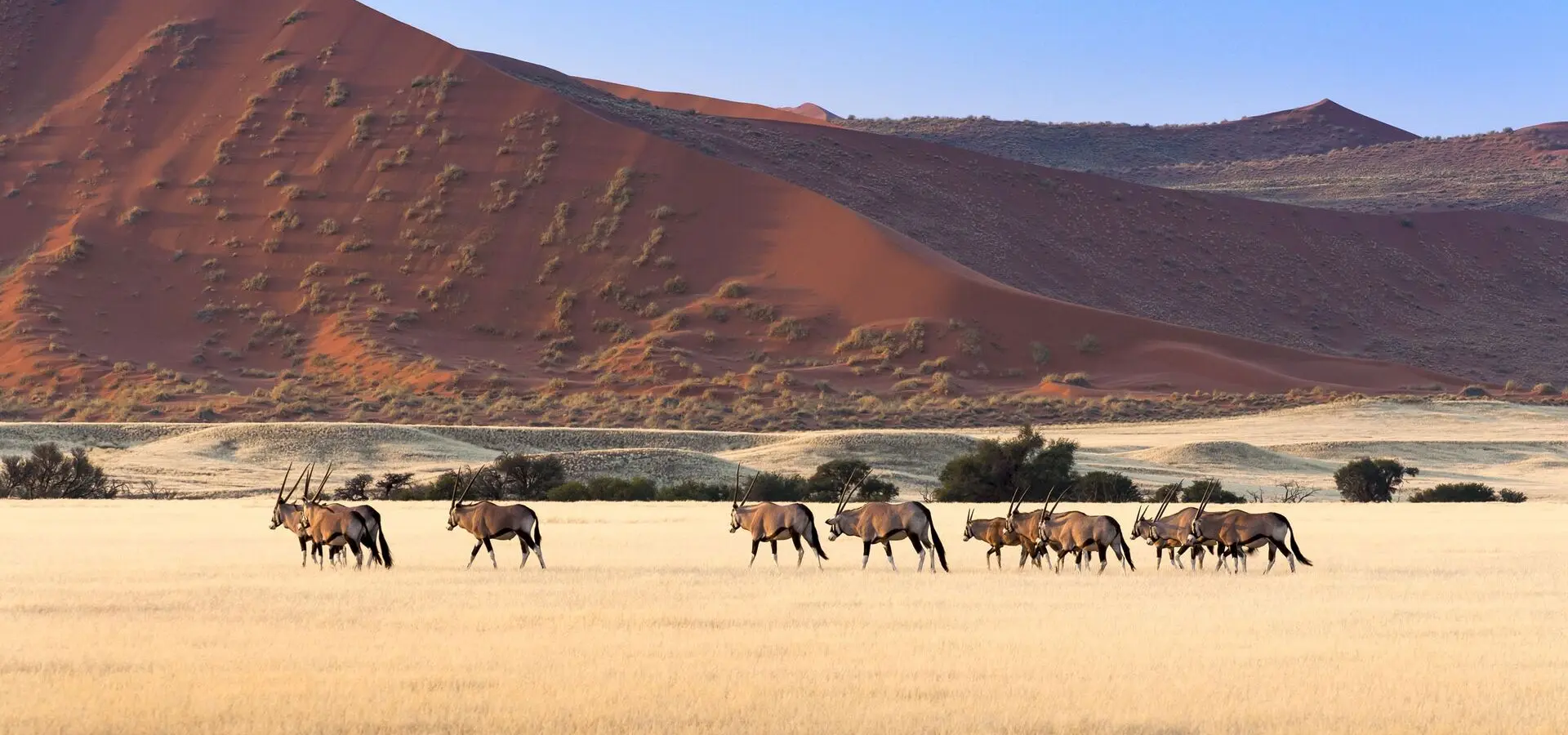
Discover Namibia on a luxurious and exclusive self-drive tour of the country's main highlights. This trip is fully tailor-made and combines the freedom of self-driving with comfortable lodges and tented camps in special locations. You will start in the south at the impressive Fish River Canyon, one of the largest canyons in the world, where you will experience the vast landscapes and deep silence of the area. You then travel to the coast and visit places like Lüderitz and Swakopmund. Here you will see the influences of German history and explore the area with activities such as boat trips or desert excursions. You will then drive to Sossusvlei, famous for its high red sand dunes. In the early morning, explore this iconic area and see how the soft light keeps bringing the landscape to life. The journey ends in Etosha National Park, where you will spend several days on safari. You will drive yourself through the park and spot impressive animals such as elephants, giraffes and lions. After each travel day, you will stay in comfortable accommodations, so you will travel in peace and enjoy plenty of comfort and personal service.
Travel programme
Travel overview
- Day 1 Flight to Johannesburg
- Day 2 Travel day to Windhoek
- Day 3 – 4 The Kalahari Desert
- Day 5 – 6 The valleys of Fish River Canyon
- Day 7 Spot wild horses near Aus
- Day 8 Leaving Kolmanskop
- Day 9 – 10 The dunes of Sossusvlei
- Day 11 – 12 Stay in picturesque Swakopmund
- Day 13 – 14 Discover ancient rock engravings in Twyfelfontein
- Day 15 – 16 On safari in the Ongava Private Game Reserve
- Day 17 Safari in Etosha National Park
- Day 18 – 19 Okonjima Nature Reserve
- Day 20 Departure from Namibia
Air travel to Johannesburg
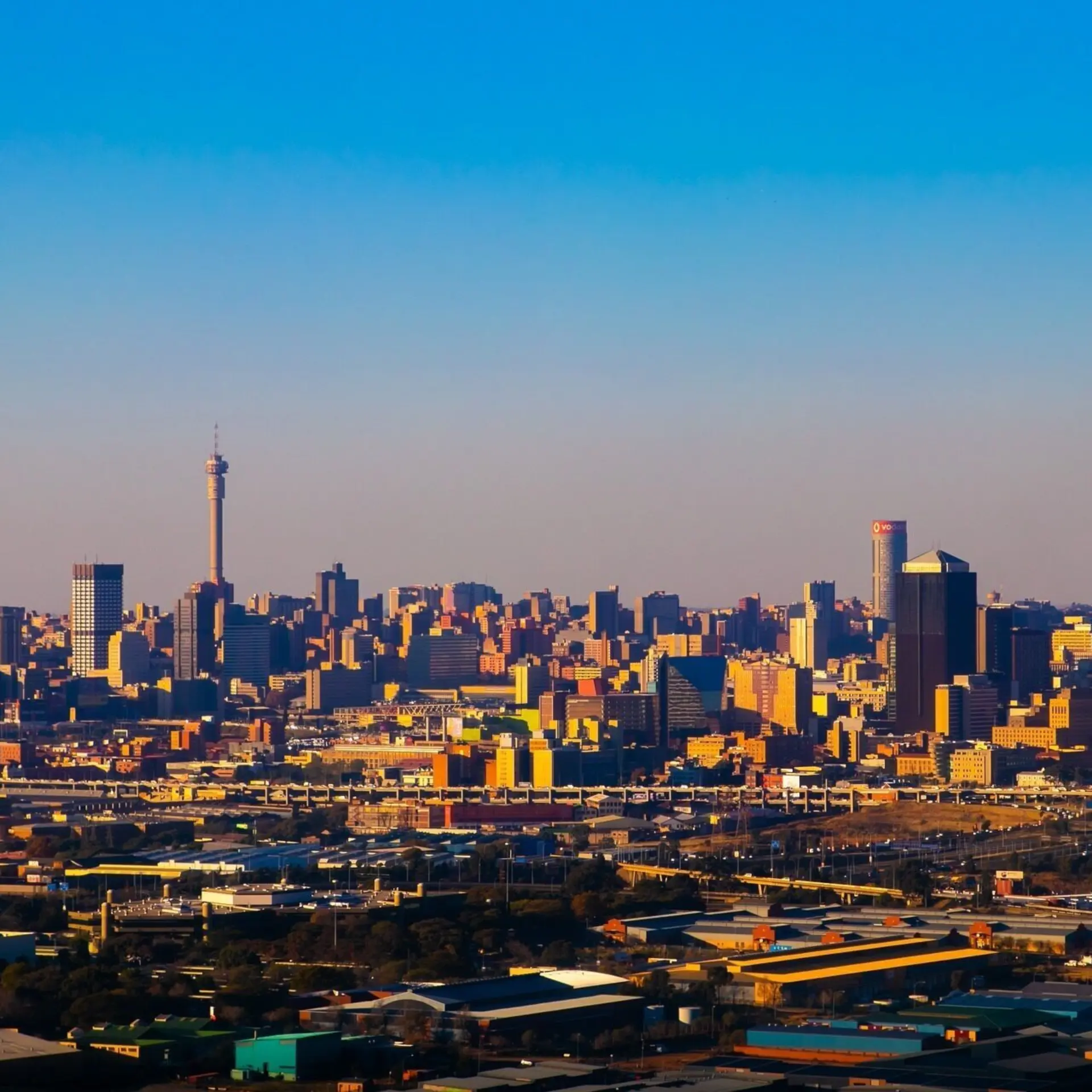
After arriving in the South African city of Johannesburg, you can easily walk to your hotel as it is located opposite the arrivals hall. Then you can start enjoying your well-deserved night's sleep.
Tips from the Travel Specialist
Please note: your luggage may be through-checked to your final destination. When checking in at your departure airport, ask whether you can collect your luggage in Johannesburg so that you can use it at the hotel that evening.
Included:
• Accommodation including breakfast
Exclusive:
• Intercontinental flight to Johannesburg
Travel day to Windhoek
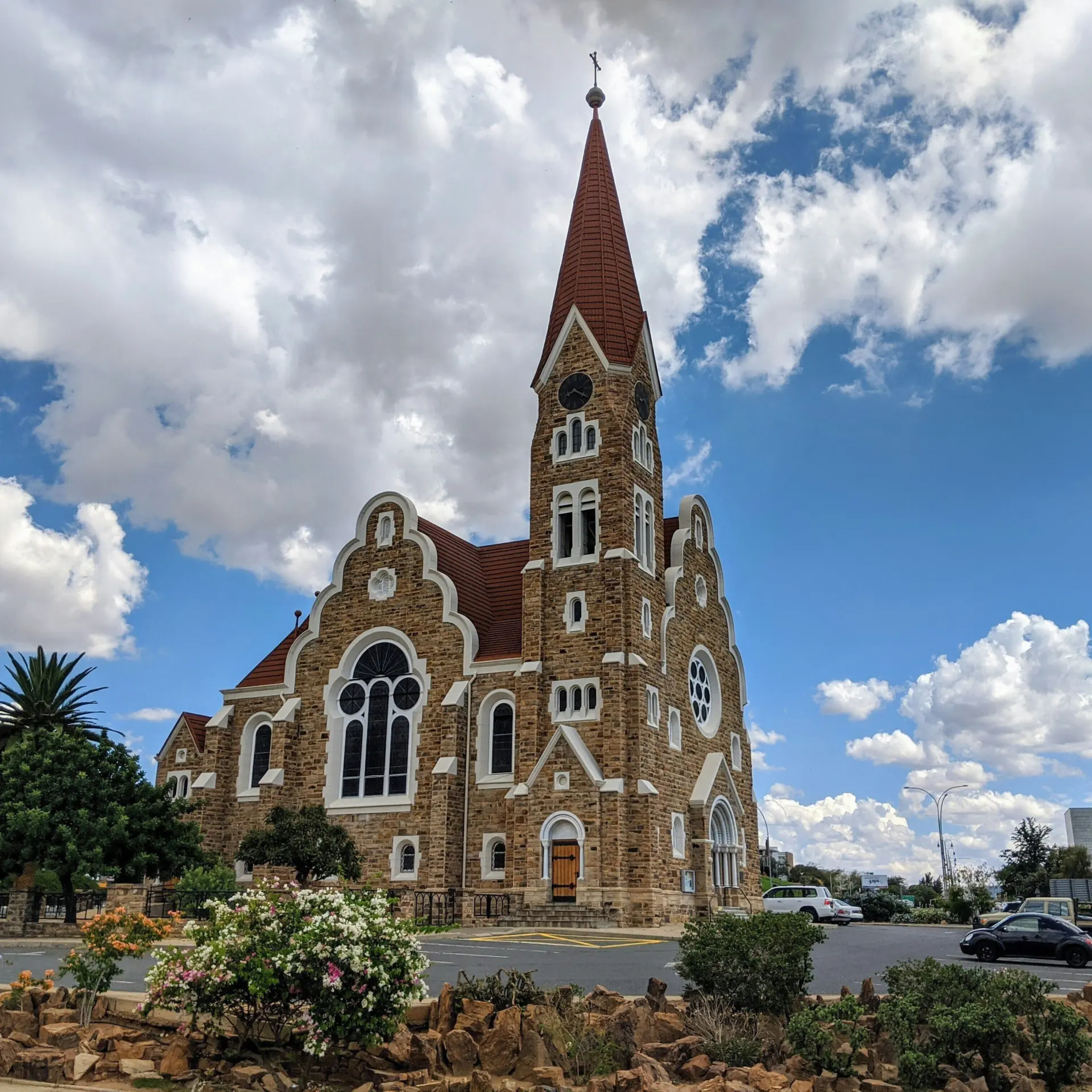
After your international flight, you will arrive in Namibia's capital, Windhoek. A relatively small city in the centre of the country, it grew up around a settlement with water springs on top of a hill. It is a city with a relaxed atmosphere and where German influences are still widely present. At the airport, you will be welcomed by our local representative in Namibia, who will go through the itinerary with you. You will be given a rental car, which will be at your disposal for the next few weeks. Your first night on Namibian soil you will stay at hotel Heinitzburg, which is located in a green suburb of Windhoek.
Included:
• International flight Johannesburg – Windhoek (Economy Class)
• Meet & Greet on arrival
• Car hire
• Overnight accommodation including breakfast
The Kalahari Desert

Your tour of Namibia really starts today. On your own you will drive south towards the Kalahari. The Kalahari Desert covers a large area of South Africa, Namibia and Botswana. The part that Namibia covers partly contains the "succulent Karoo". An area of succulents, yuccas and cactus-like plants of which as many as 5,000 different species have been counted in the area. The area is also known for its red sand dunes and so-called Inselbergen (isolated mountains) with their own microclimate. You will stay in special accommodation in the middle of the desert.
Included:
• Hire car
• Accommodation on a half-board basis
The valleys of Fish River Canyon
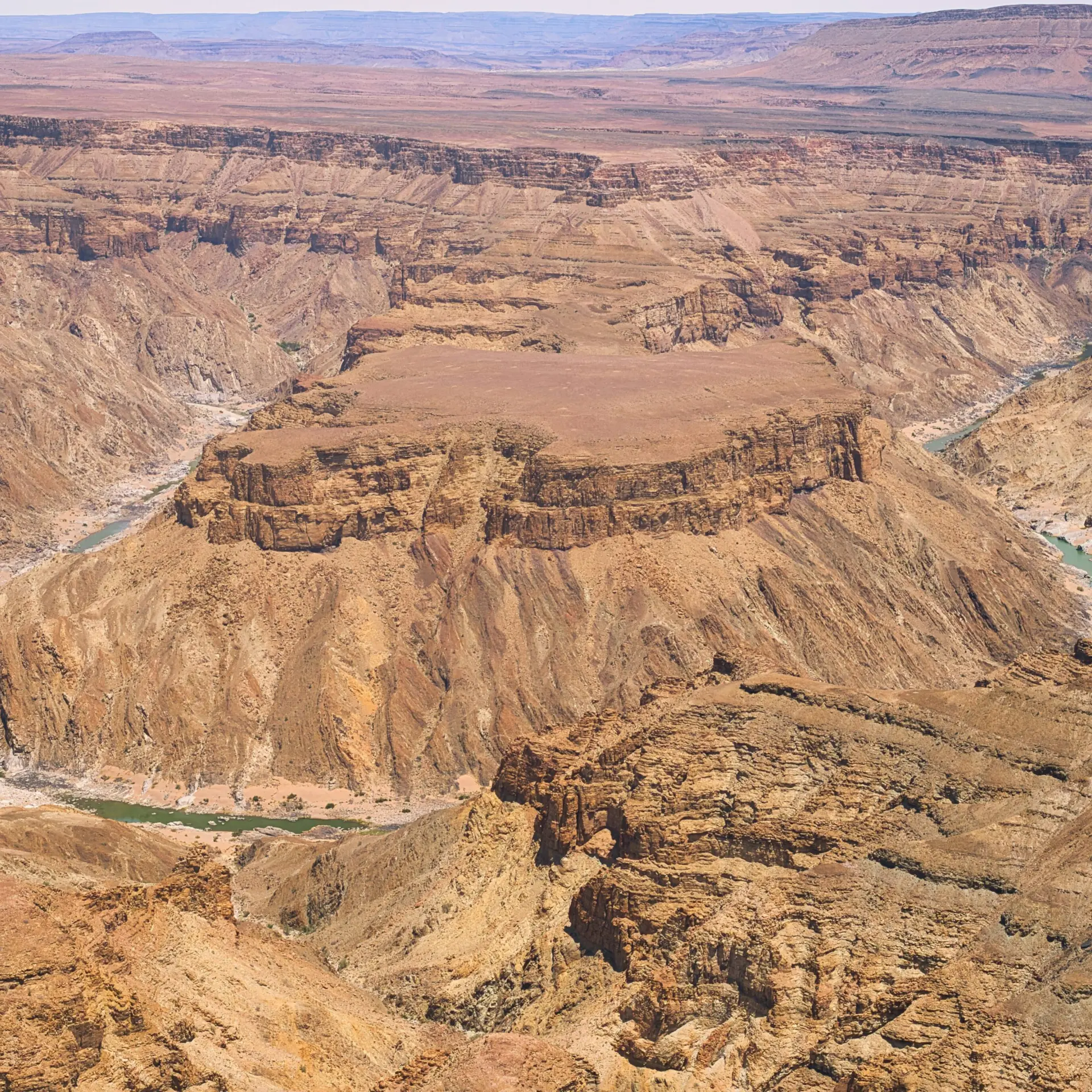
The journey continues further south. After the Grand Canyon in America, the Fish River Canyon is the longest canyon in the world. It is thought to be around 500 million years old and has been carved ever deeper over time by erosion. The canyon is approximately 160 kilometres long. Within this canyon, you can enjoy various viewpoints. You’ll be staying at the unique Fish River Lodge, which is built on the rim of the canyon. Enjoy the stunning views from your room!
During your stay, you’ll have the option of going on guided walks through this fascinating area. You can also enjoy a special sunset drive.
Included:
• Hire car
• Accommodation on a half-board basis
Spot wild horses near Aus
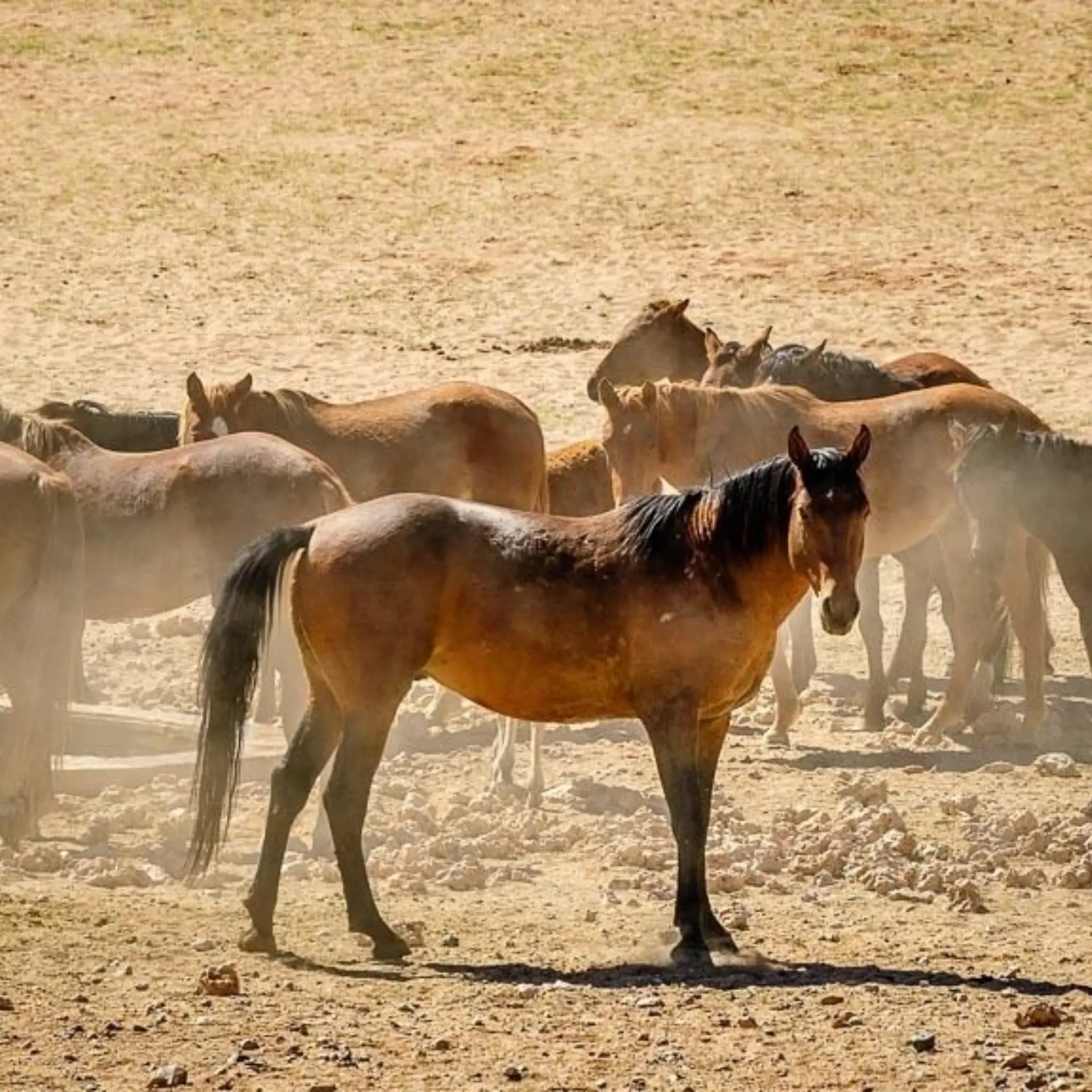
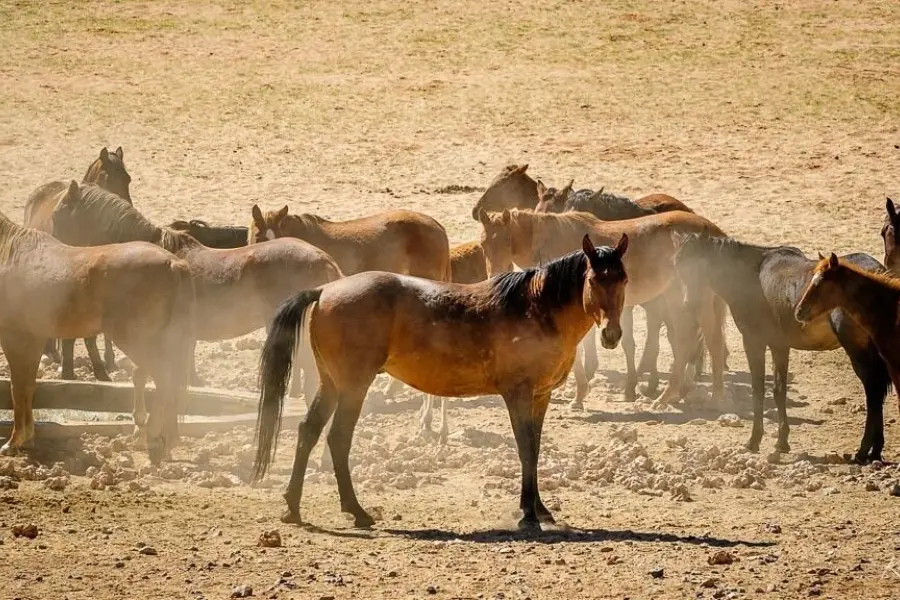
At the edge of the Namib Desert, you’ll enter an area home to a large population of wild desert horses. Over time, these feral horses have adapted to the harsh desert conditions and can survive without drinking water for several days at a time. Legend has it that these horses belonged to the German cavalry and were abandoned after the First World War. Others say they were driven here from the Orange River, whilst a third group is convinced they are the surviving horses from a cargo ship that ran aground on the Skeleton Coast whilst en route to Australia.
Your destination is the village of Aus, with a population of around 300. After the Germans were defeated by South Africa in the First World War, around 1,500 German prisoners of war were held here, guarded by 600 South Africans. A small town with a rich history, where you will spend the night.
Included:
• Hire car
• Accommodation on a half-board basis
The abandoned Kolmanskop
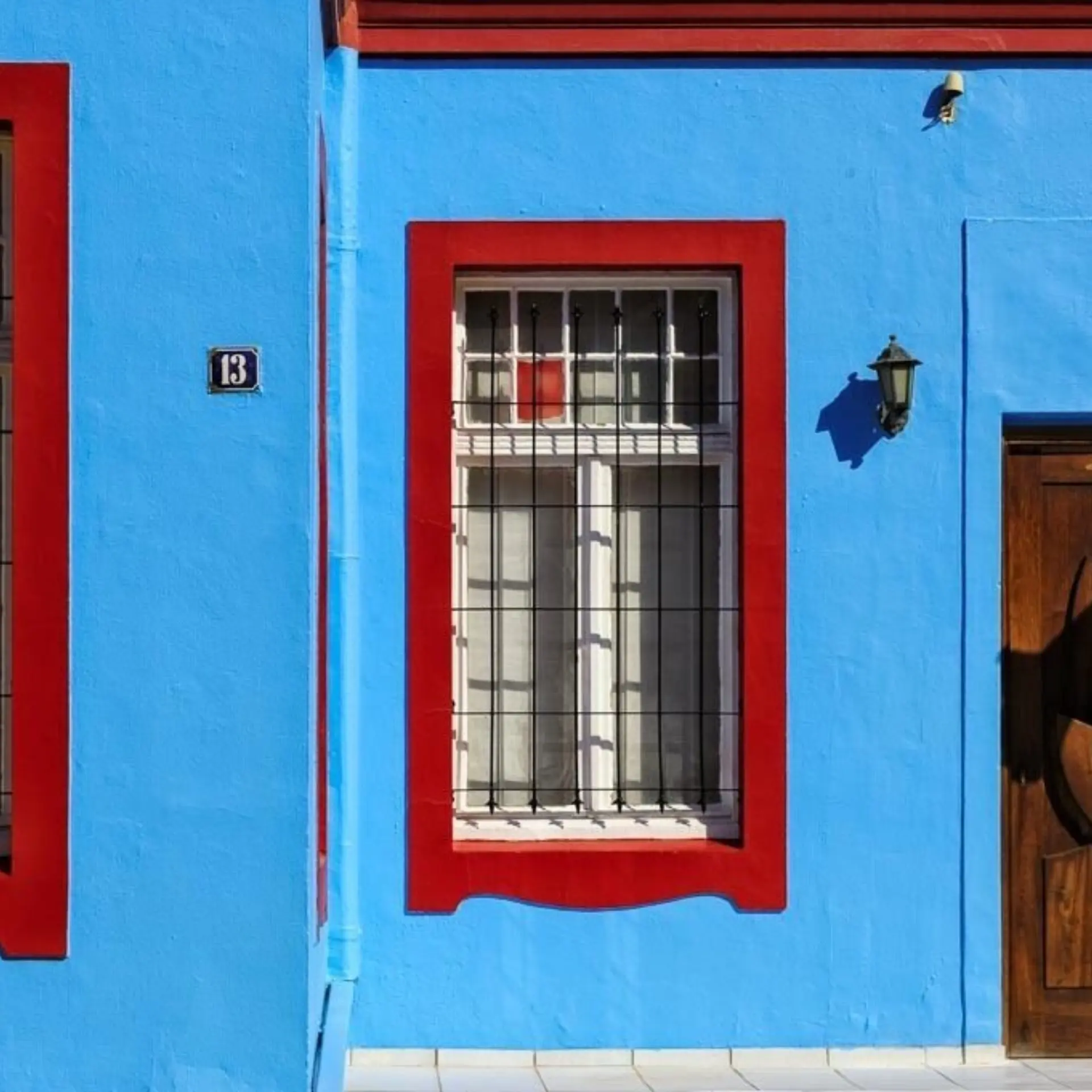
Today, you can drive towards the coast to visit the town of Lüderitz. This town is situated on a bay on Namibia’s south-west coast. This striking town was the first German settlement in German South-West Africa and was founded in the Namib Desert during the German colonial era. The town still retains its German character to this day. In the bay, you can spot numerous penguins, seals, porpoises and dolphins, as well as whales.
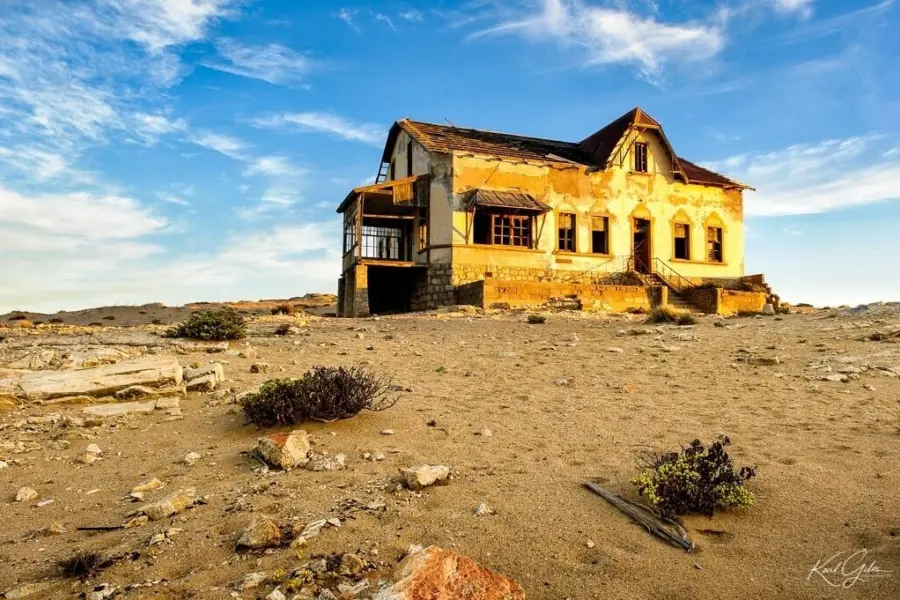
We recommend you also visit the nearby Kolmanskop. It offers a truly surreal experience: a ghost village in the middle of the desert. Diamonds were once found here. Over time, the village fell into disrepair as the miners moved closer to the coast, and the abandoned village fell prey to the desert sand, with the buildings gradually being filled in. However, this does make for some stunning scenes. Since being abandoned, the village has featured in several films.
After your visit to the coast, the drive back to Aus takes about an hour and a half.
Included:
• Hire car
• Accommodation on a half-board basis
The dunes of Sossusvlei
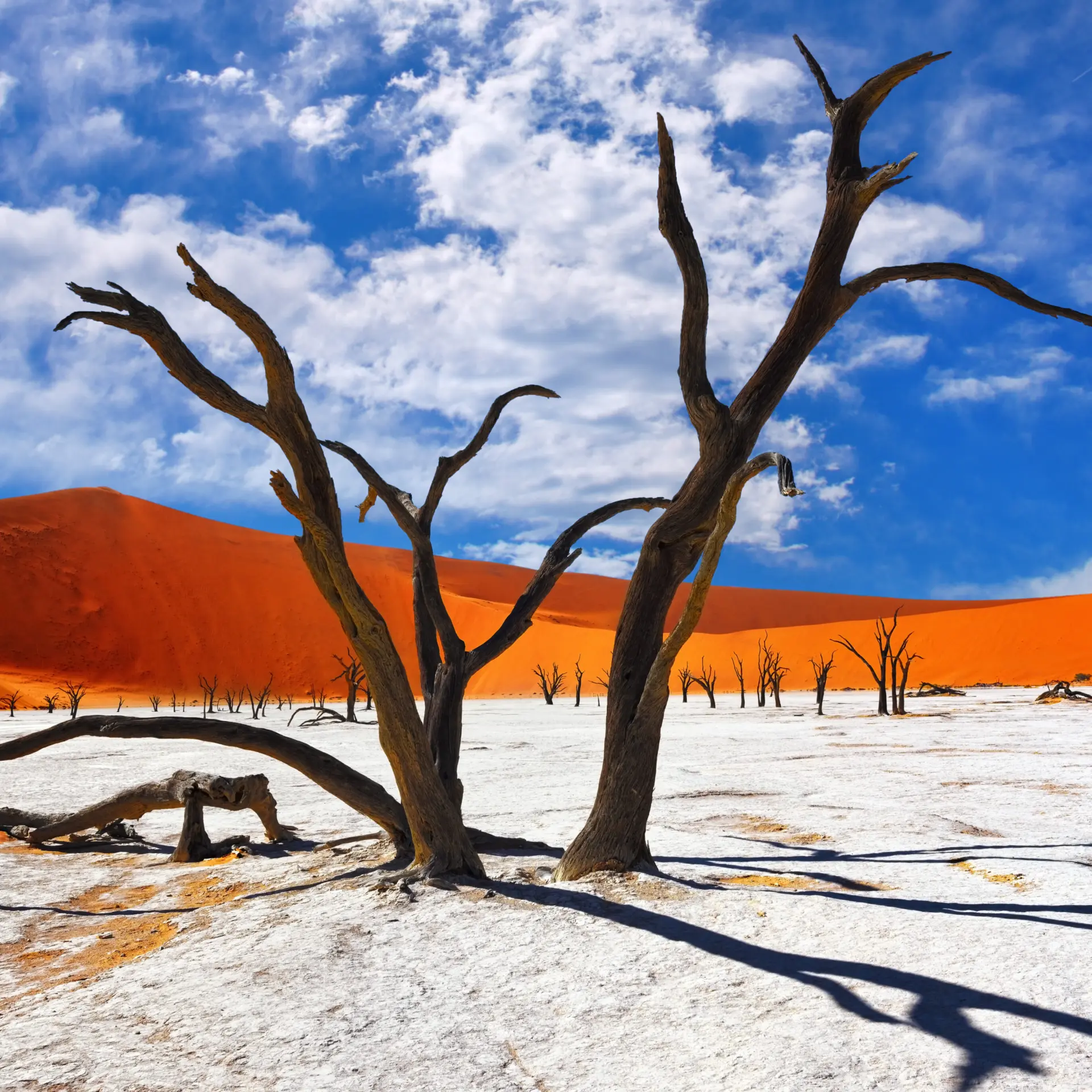
In the heart of the Namib Desert lies a clay pan known as Sossusvlei – this is your next destination. As well as Sossusvlei itself, Deadvlei and the Sesriem Canyon are also well worth a visit. You will explore this area accompanied by a knowledgeable guide.
This area is at its most beautiful, particularly in the morning as the sun rises or during magnificent sunsets. As the sun moves across the sky during the day and only one side of the dunes is bathed in sunlight, razor-sharp contrasts emerge between the two sides of the dunes. Once the sun has set, you can enjoy a stunning starry sky.
As an optional extra during your stay, you can take a hot-air balloon ride over the stunning dune landscape in the morning!
Includes:
• Hire car
• Guided Sossusvlei excursion
• Accommodation on a half-board basis
Staying in picturesque Swakopmund
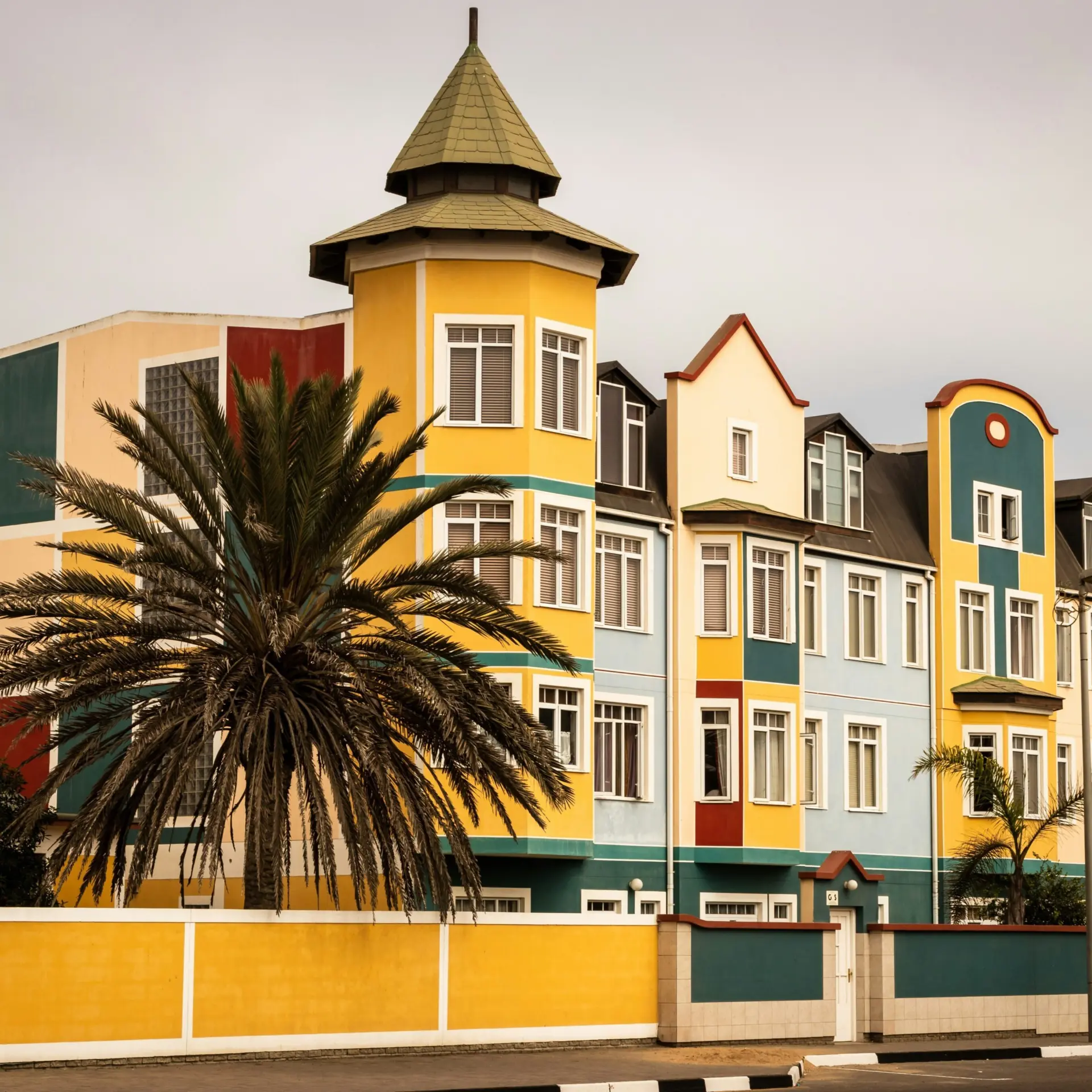
As you drive into Swakopmund, your first impression is that you’re in Germany. German architecture, the sound of German being spoken, and signs such as ‘Kaffee mit Kuchen’ and a genuine ‘Konditorei’. This little town on the Atlantic Ocean has a wide promenade lined with palm trees, and it’s a peaceful and relaxed place to spend some time.
There’s plenty to do in and around Swakopmund. An hour’s drive north at Cape Cross, you’ll find the seal reserve where thousands of sea lions live. In the dunes around Swakopmund, you can go sandboarding. Sitting, lying down or standing on a sandboard as if you were on a winter sports holiday, you can surf down from the dune tops. Or pop down to the beach near your hotel to unwind, go horse riding, quad biking or even skydiving. You can also take a catamaran trip along the coast in search of dolphins and pelicans. The sea lions from Cape Cross often pop over to visit the boat, too.
It’s also great fun to head into the desert on a half-day excursion with an expert guide. During the tour, the guide knows exactly where to find remarkable animals in a sea of sand where life seems almost impossible.
Included:
• Hire car
• Accommodation including breakfast
Discover ancient petroglyphs in Twyfelfontein
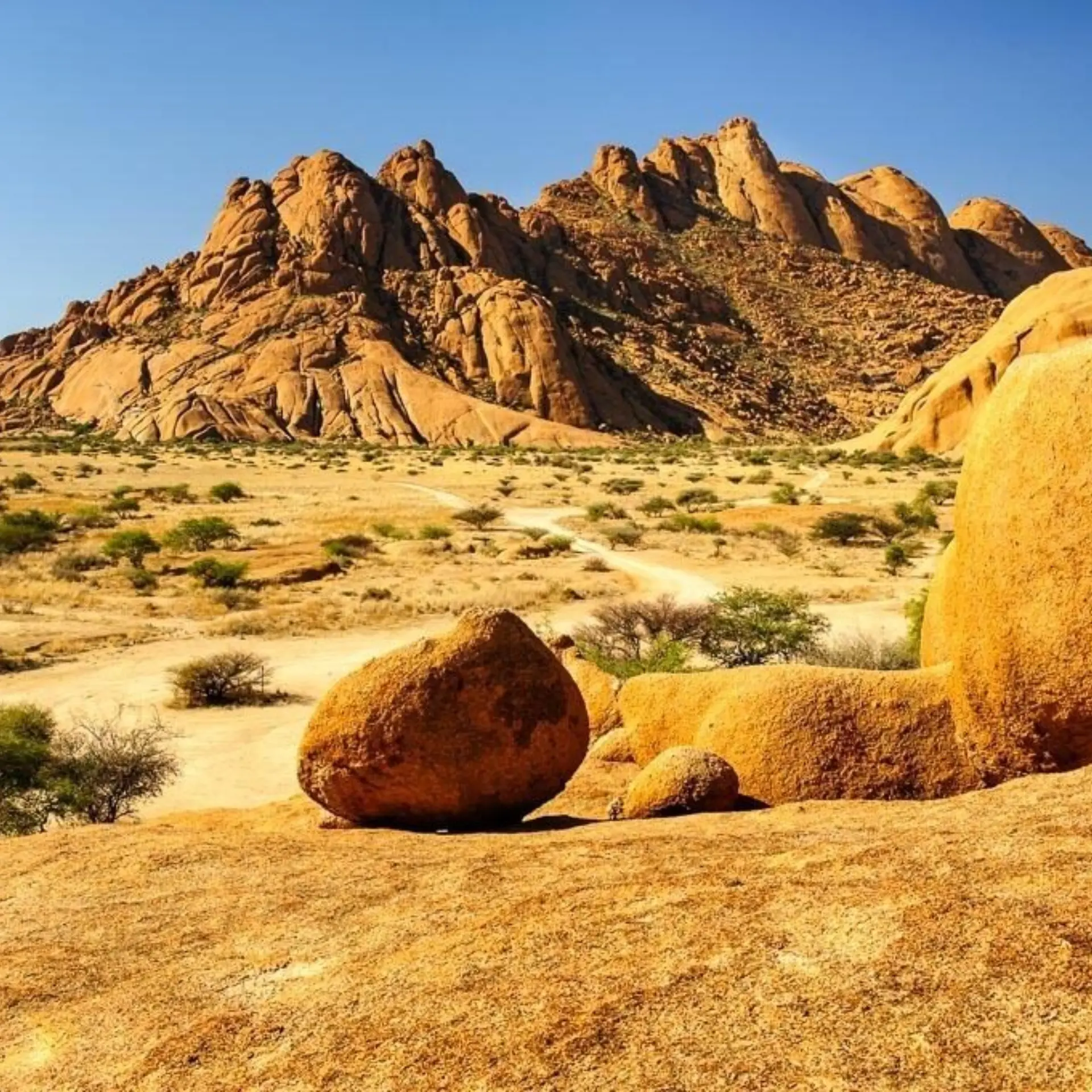
On your way to Damaraland, you will enter the area where the San Bushmen tribe lived. They communicated with each other through rock drawings, which can still be seen. Some are thousands of years old. Optionally, you can go to see the rock drawings together with a local guide. You will see drawings of elephants, giraffes and people and learn the story behind some of the drawings during the excursion. It is also possible to encounter desert elephants in the inhospitable landscape. A very special and especially rare experience! You can also visit the Petrified Forest. Here you will see as many as 250 million-year-old tree trunks that are petrified, but can still be recognised as being a tree trunk. Research has shown that the trees did not come from here.
Included:
• Hire car
• Accommodation on a half-board basis
On safari in Ongava Private Game Reserve

You’ll continue northwards towards one of the absolute highlights of the trip. Etosha ‘Great White Place’ National Park is one of the largest nature reserves in Southern Africa and covers an area roughly three-quarters the size of the Netherlands. The park consists largely of a vast salt pan surrounded by bush. A wide variety of wildlife can be spotted in the park, including elephants, zebras, lions and various species of antelope.
You’ll be staying at the Ongava Private Game Reserve. This private reserve is situated south of the national park and offers an exclusive experience. The accommodation is extremely luxurious and, what’s more, activities such as guided game drives are included. Ongava is truly special, as it offers you the chance to spot both black and white rhinos. A unique experience!
Included:
• Hire car
• Accommodation on a full-board basis, including (shared) safari activities
Safari in Etosha National Park
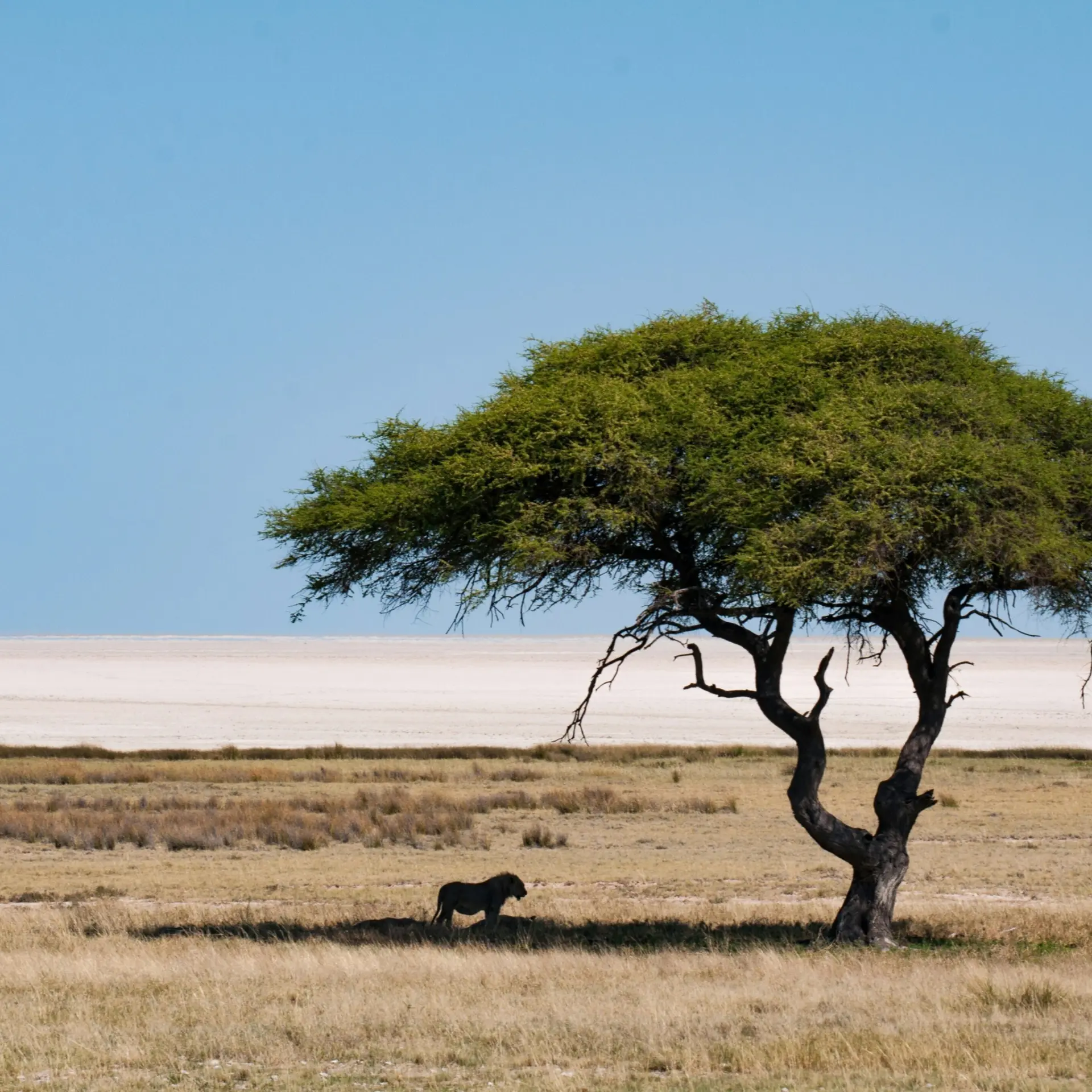
Today you will traverse the famous Etosha National Park by your own car. Explore by yourself and feel the excitement when you track a group of animals yourself. Truly a unique experience. At the end of the day, relax at your lodge and reminisce about this special experience.
Included:
• Hire car
• Accommodation on a half-board basis
Exclusive:
• Entry fees for Etosha National Park
Okonjima Nature Reserve
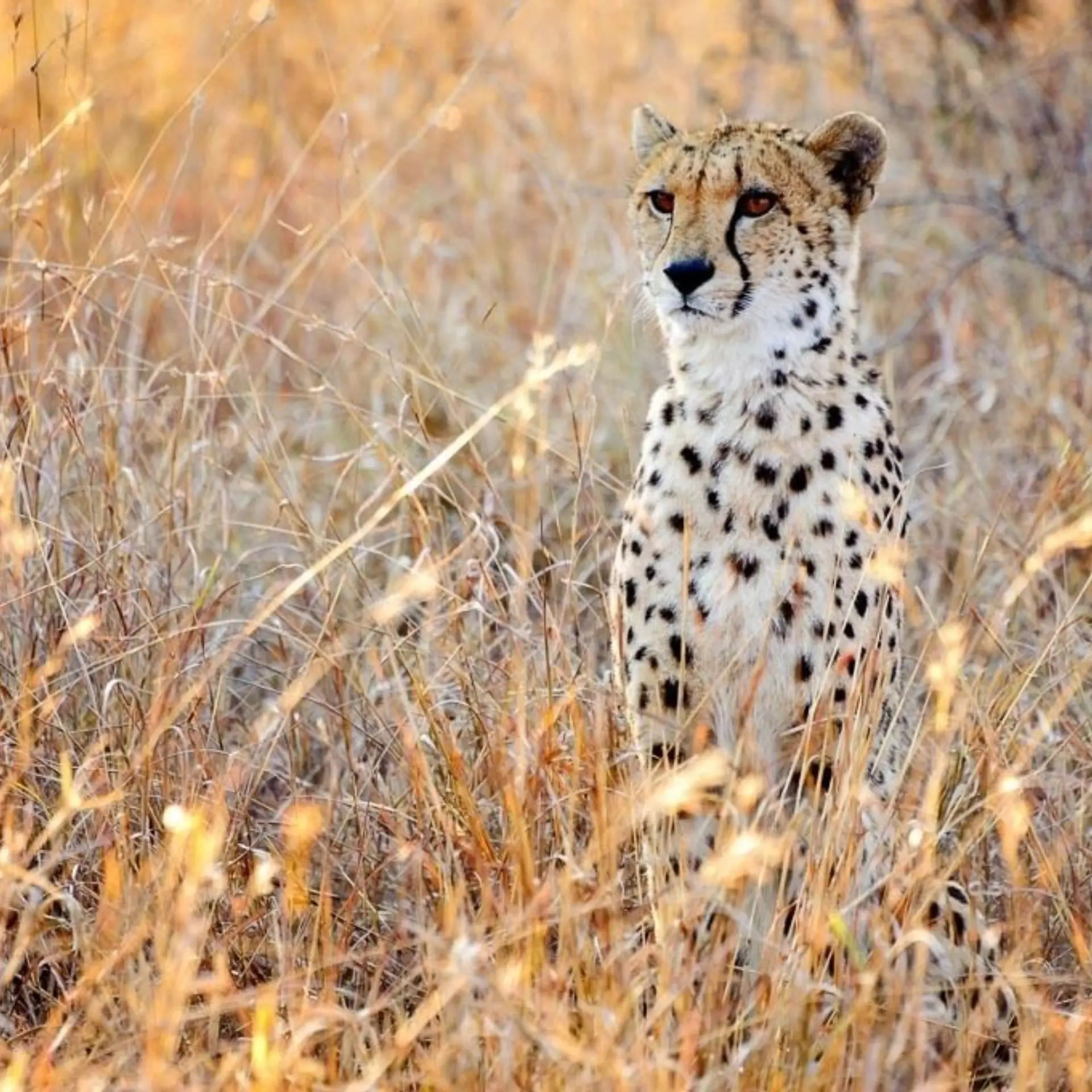
You’ll bid farewell to Etosha National Park and travel on to Okonjima Nature Reserve. After arriving at your luxury lodge, you’ll have the rest of the morning to relax. Following a light lunch, you can optionally take part in the activities offered by the lodge. You could go on a game drive in search of the rare leopard. You could also visit the Cheetah Project, go on a guided walk in search of big game, or follow the Bushman Trail. This final destination in beautiful Namibia also offers you the ultimate opportunity to photograph wildlife at very close quarters.
Okonjima is also actively involved in wildlife conservation. Here you’ll find the AfriCat Foundation and the Cheetah Project – both inspiring initiatives in the field of wildlife management.
Included:
• Hire car
• Accommodation on a half-board basis
Accommodations
City Lodge OR Tambo Airport
This City Lodge is located close to OR Tambo Johannesburg Airport. And gives travellers the feeling of home, the ideal place when you are travelling and need to stay near the airport. The hotel has a fitness room and a deck with a swimming pool, some great shops with a bar where you can have coffee...
This City Lodge is located close to OR Tambo Johannesburg Airport. And gives travellers the feeling of home, the ideal place when you are travelling and need to stay near the airport. The hotel has a fitness room and a deck with a swimming pool, some great shops with a bar where you can have coffee. At the airport, you will find many services such as restaurants, shops and banks.
Your stay: 1 night

Hotel Heinitzburg
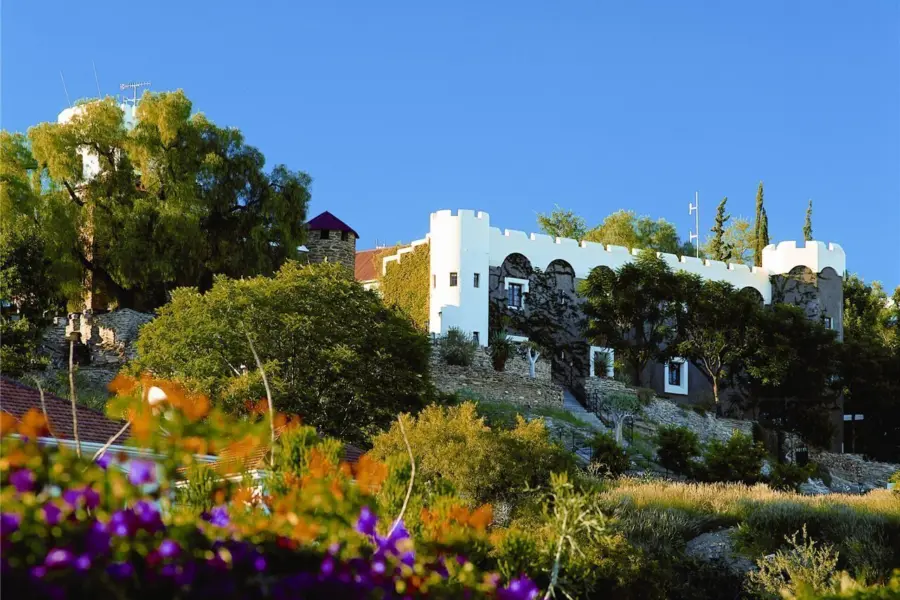
Heinitzburg is one of a kind. Its location is beautiful, on top of a hill at the edge of town. This gives you a beautiful panoramic view of Windhoek, Namibia's capital. Not only is it a great place to spend the night at the beginning or end of a trip, the hotel also features a...
Heinitzburg is one of a kind. Its location is beautiful, on top of a hill at the edge of town. This gives you a beautiful panoramic view of Windhoek, Namibia's capital. Not only is it a great place to spend the night at the beginning or end of a trip, the hotel also features a gourmet restaurant and well-stocked wine cellar.
In the hotel's peaceful garden, you can relax in a private atmosphere while enjoying the refreshing swimming pool (heated in winter).
The hotel offers 16 spacious, generously furnished rooms with en suite bathrooms, private air conditioning/heating, telephone, electronic safe, minibar, flat-screen TV with satellite channels. The superior deluxe rooms have a bath with integrated showers, while the deluxe rooms all have a shower.
The Hotel Heinitzburg has a range of dining options. These include the aforementioned gourmet restaurant overlooking the city skyline (serves a variety of dishes ranging from local to international). The Garden Terrace offers stunning views of the city and surrounding mountains. Here, simpler meals, coffee and pastries from the patisserie are served during the day, while evening snacks and sundowner cocktails are served overlooking stunning vistas of spectacular sunsets. And there is of course Wine Cellar, which houses a large collection of carefully selected South African wineries. Built into the mountain rock, the cellar also offers ruite for private dining.
Your stay: 1 night
Kalahari Red Dunes Lodge
Kalhari Red Dunes Lodge, a lodge designed with great passion for detail, is set in the impressive Kalahari landscape characterised by red sand dunes and camel thorn trees. The main building, consisting of reception, lobby, restaurant and bar, a swimming pool and shaded terrace is set in a dry lake (vlei). A...
Kalhari Red Dunes Lodge, a lodge designed with great passion for detail, is set in the impressive Kalahari landscape characterised by red sand dunes and camel thorn trees. The main building, consisting of reception, lobby, restaurant and bar, a swimming pool and shaded terrace is set in a dry lake (vlei). A 120-metre boardwalk connects the main building to the chalets, which are located around the 'vlei, where animals can often be observed. Each chalet has a thatched roof, canvas and stone section, as well as a private terrace. During Nature / Game drives and nature walks, guests can experience the breathtaking beauty of the Kalahari with red dunes and a wide variety of wildlife.
Experience the vastness of the African savannah on the optional 2-day Trans Kalahari Walk. This guided walk leads through the desert-like settings and habitat of giraffes, zebras and antelopes and offers an overnight stay in a luxury tented camp in the dunes.
Your stay: 2 nights
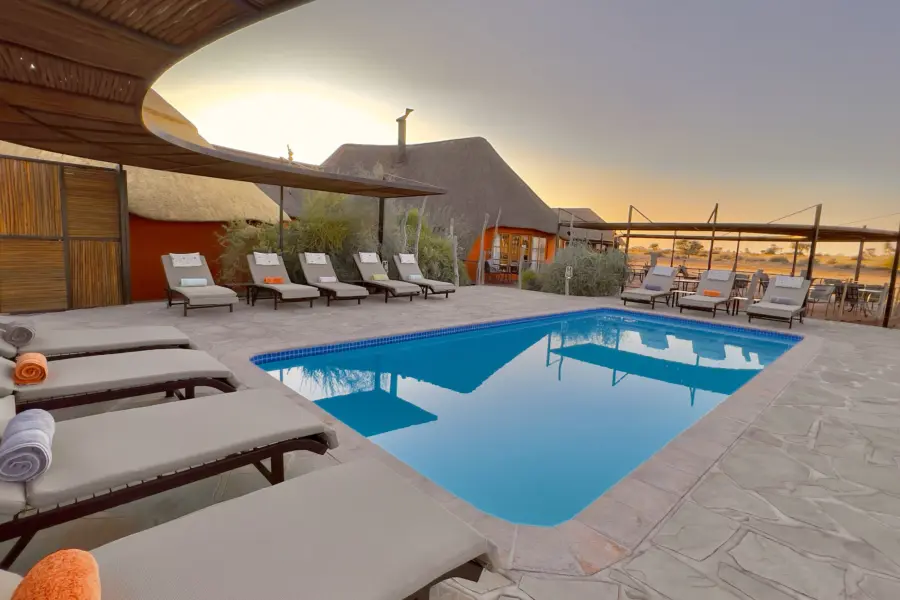
Fish River Lodge
Fish River Lodge in southern Namibia is the only lodge located directly on the edge of Fish River Canyon, offering guests breathtaking views of the canyon from sunrise to sunset. Behold the geological forces that began 300 million years ago, when the Fish River began to make its way up the...
Fish River Lodge in southern Namibia is the only lodge located directly on the edge of Fish River Canyon, offering guests breathtaking views of the canyon from sunrise to sunset. Behold the geological forces that began 300 million years ago, when the Fish River began etching its way through hard quartzite, forming a canyon 90 kilometres long, 549 metres deep and up to 28 kilometres wide in places. This makes it the world's single largest canyon . The 45000-hectare Canyon Nature Park is also a natural haven for flora and native wildlife. Hiking trails wind down to the banks of the 75km-long river. Hartmans Zebra, kudu, oryx, springbok and so many more can be encountered here.
Your stay: 2 nights
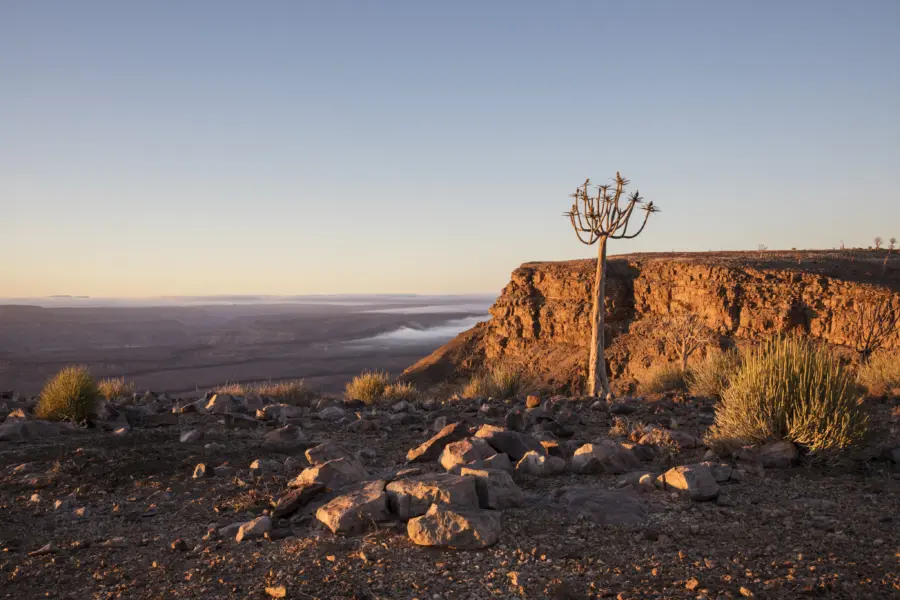
Klein-Aus Vista Eagle's Nest Chalets Gondwana Collection Namibia
Solitude, silence, space and beautiful sunsets - these are the hallmarks of the atmosphere at Eagle's Nest Chalets. A 15-minute drive from the reception of the Desert Horse Inn, the eight chalets sit against a mountainside and offer unique views of the unlimitedness of the desert. Each of the chalets sits between...
Solitude, silence, space and beautiful sunsets - these are the hallmarks of the atmosphere at Eagle's Nest Chalets. A 15-minute drive from the reception of the Desert Horse Inn, the eight chalets sit against a mountainside and offer unique views of the unlimitedness of the desert. Each of the chalets sits between massive granite boulders, and features a bathroom, kitchenette, fireplace and private veranda. Meals are served in the Desert Horse Inn restaurant. Take-away breakfast or barbecue packs are available on request.
Your stay: 2 nights
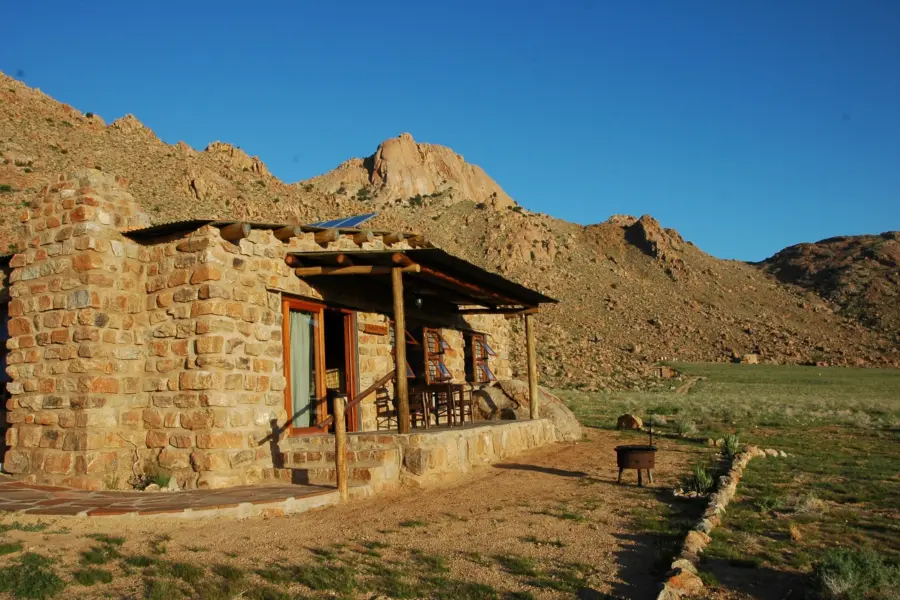
Wilderness Kulala Desert Lodge
Kulala Desert Lodge is located at the foot of the majestic Sossusvlei dunes with its own entrance (for Wilderness Safaris vehicles only) to Namib Naukluft Park. This makes Kulala Desert Lodge the closest location to the Sossusvlei. It has stunning views of the famous red dunes, mountainous...
Kulala Desert Lodge is located at the foot of the majestic Sossusvlei dunes with its own entrance (for Wilderness Safaris vehicles only) to Namib Naukluft Park. This makes Kulala Desert Lodge the closest location to the Sossusvlei. It has stunning views of the famous red dunes, mountainous landscapes and wide open plains which makes this Lodge very spectacular.
The camp consists of 23 thatched and canvas "kulalas" with en-suite bathrooms and verandas. Each unit is built on a wooden platform and has a flat roof. The main area, with North African-inspired décor, has a living room, dining area, a swimming pool, and a veranda overlooking a well.
Activities are very impressive due to the overwhelming size, solitude and tranquillity of the desert. Activities include private tours to Sossusvlei, scenic nature walks and drives to the desert's fascinating flora and fauna. At extra cost, it is also possible to experience the area in the form of a hot air balloon safari.
Pack for a purpose
Kulala Desert Lodge is affiliated with Pack for a Purpose. Pack for a Purpose is a charitable organisation that allows travellers to spend several kilos of their luggage weight to help local residents. Think school supplies, clothes, medical equipment and other necessities donated to the local project through the lodge. To make sure you bring what is actually needed locally, the lodge explains the project.
Click here for information about the project at Kulala Desert Lodge:
https://www.packforapurpose.org/destinations/africa/namibia/kulala-desert-lodge-and-little-kulala/
Your stay: 2 nights
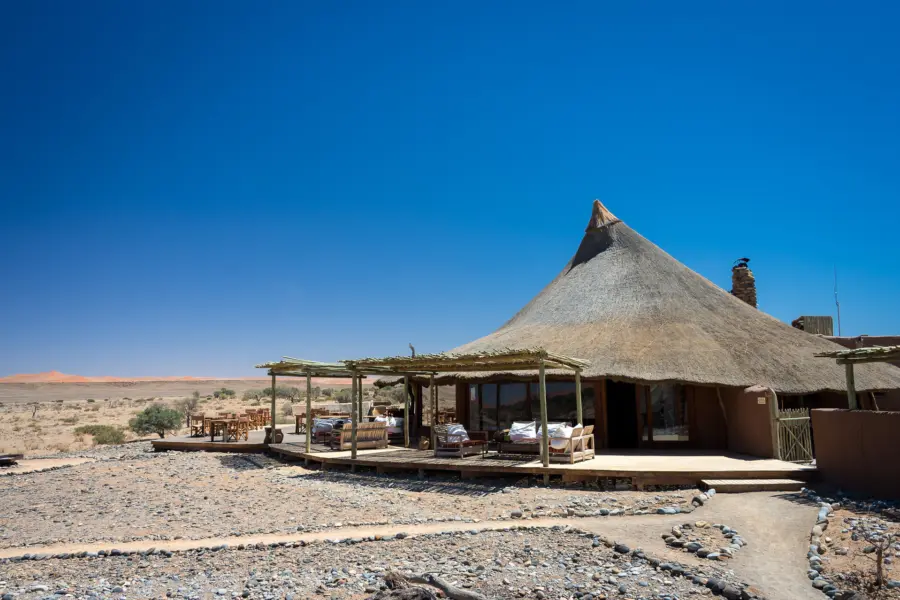
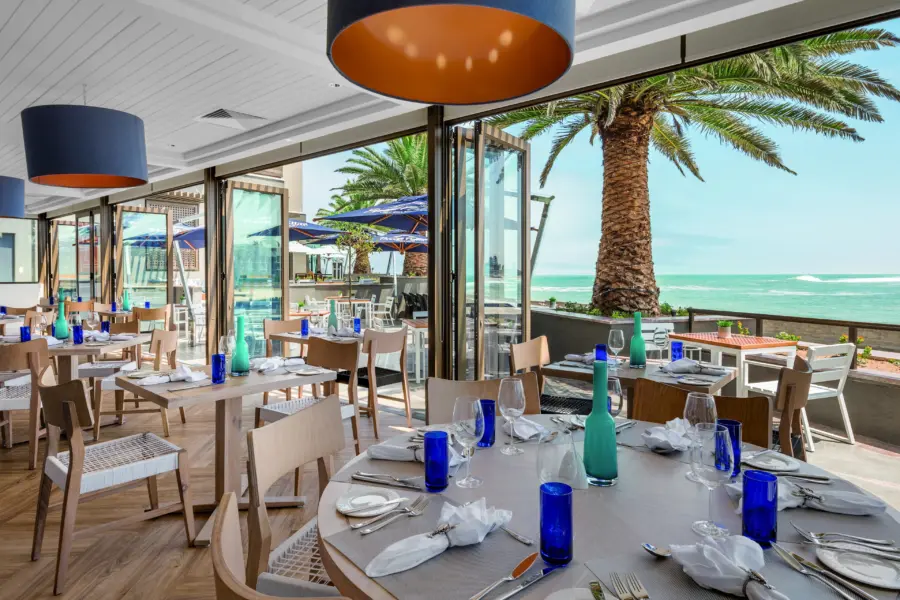
Beach Hotel Swakopmund
The Strand Hotel Swakopmund is located right on the promenade in Swakopmund, surrounded on three sides by the Atlantic Ocean, with direct access to the beach and a five-minute walk from the historic centre of Swakopmund with all its shops, cafés, restaurants and bars.
The Strand Hotel Swakopmund offers...
The Strand Hotel Swakopmund is located right on the promenade in Swakopmund, surrounded on three sides by the Atlantic Ocean, with direct access to the beach and a five-minute walk from the historic centre of Swakopmund with all its shops, cafés, restaurants and bars.
The Strand Hotel Swakopmund offers restaurants, bars, deli, lobby/lounge, sea view terraces and shops, all in a historic and iconic location.
The hotel's architectural inspiration finds its roots deep in Namibian German colonial history and reflects it in a tasteful contemporary way.
The hotel has 125 rooms, 90% of which have beach and/or sea views and 10% have garden views.
Your stay: 2 nights
Mowani Mountain Camp
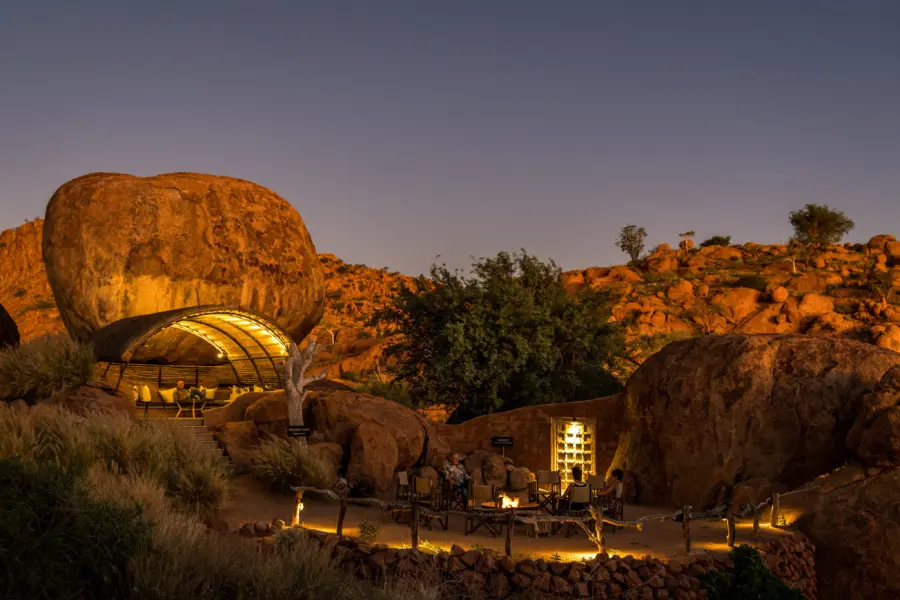
Mowani Mountain Camp offers luxury tented accommodation with stunning desert views. From the private bathroom, which is placed outside, and your own private terrace, you can enjoy the views of Damaraland and nearby Twyfelfontein. This place is known for its San rock drawings, which are...
Mowani Mountain Camp offers luxury tented accommodation with stunning desert views. From the private bathroom, which is placed outside, and your own private terrace, you can enjoy the views of Damaraland and nearby Twyfelfontein. This place is known for its rock drawings by the San, which tribe is also known as the Bushmen. Furthermore, in this area you also have the chance of encountering a real desert elephant. These animals have fully adapted to the area's climate.
The local nature conservancy ensures that the habitat of the desert elephant, among others, as well as the black rhinoceros, remains protected. At Mowani, everything is about sustainability and the local community. Thus, the guides are from this local community and they conduct daily game drives to look for zebras, kudu, springboks, klipspringers and if you are really extremely lucky, maybe even a leopard! Besides game drives, you have the opportunity to take a balloon ride over the Aba-Huab valley, enjoy a champagne breakfast and, of course, have meals in the middle of the twilight desert under the Mopani trees.
Your stay: 2 nights
Ongava Lodge
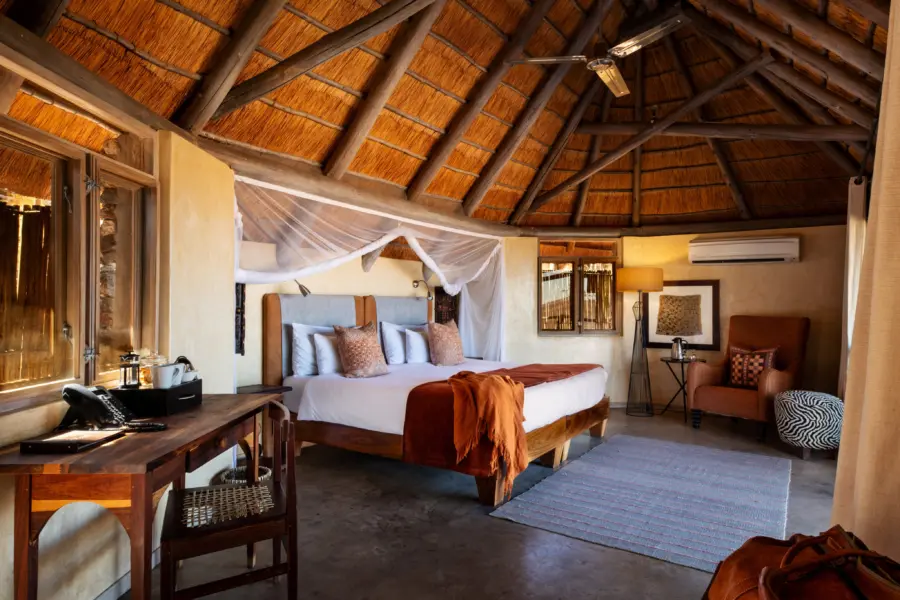
The Ongava Lodge is located in the privately owned Ongava Game Reserve along the southern border of Etosha National Park. It has a beautiful vantage point overlooking a well-visited waterhole and the plains around it. Ongava Lodge is a luxurious accommodation with 4 en suite chalets. There is a lounge, dining area and...
The Ongava Lodge is located in the privately owned Ongava Game Reserve along the southern border of Etosha National Park. It has a beautiful vantage point overlooking a well-visited waterhole and the plains around it. Ongava Lodge is a luxurious accommodation with 4 en suite chalets. There is a lounge, a dining area and an inviting swimming pool to cool off in the heat of the day. Meals are served in the main dining room or you can dine under the stars on the deck. Activities include safari tours in Etosha and nature tours and walks. Ongava has white and black rhinos, giving guests the opportunity to see both species.
Your stay: 2 nights
Mushara Outpost
The Mushara Outpost has 16 custom-made "tents", which are made of wood and canvas and are located on the banks of an ancient dry riverbed. This is known to locals as an "omaramba". The Mushara Outpost is also close to the magical Etosha Pan National Park. The "tents"...
The Mushara Outpost has 16 custom-made "tents", which are made of wood and canvas and are located on the banks of an ancient dry riverbed. This is known to locals as an "omaramba". The Mushara Outpost is also close to the magical Etosha Pan National Park. The "tents" feature a homely, friendly and very comfortable atmosphere.
Your stay: 1 night
Okonjima Luxury Bush Camp
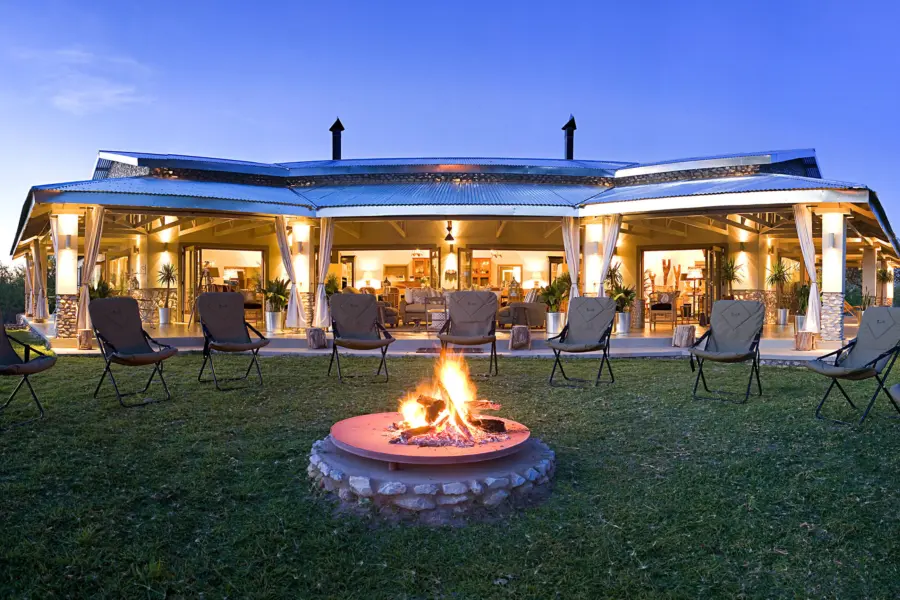
Okonjima's Luxury Bush Camp is located in the 2,000-hectare fenced nature reserve of Okonjima Nature Reserve. There is a fine restaurant and a beautiful outdoor area with a campfire to share all your safari stories with other guests. There are eight African-style chalets with thatched roofs, a junior suite...
Okonjima's Luxury Bush Camp is located in the 2,000-hectare fenced nature reserve of Okonjima Nature Reserve. There is a fine restaurant and a beautiful outdoor area with a campfire to share all your safari stories with other guests. There are eight African-style chalets with thatched roofs, a junior suite and three safari tents with private bathrooms.
It is possible to experience a variety of safari activities. Join a game drive with specialised guide or explore the bush in an adventurous way with a walking safari.
Positive Impact
Not only is Okonjima a luxury lodge, but it is also home to The AfriCat Foundation, a non-profit organisation, dedicated to the conservation of large carnivores, especially cheetah, leopards and lions. A visit to Okonjima gives you a chance to experience some of AfriCat's work up close, allowing you to go on several tracking safaris, both on foot and game drives with open 4x4s.
Your stay: 2 nights

Experiences
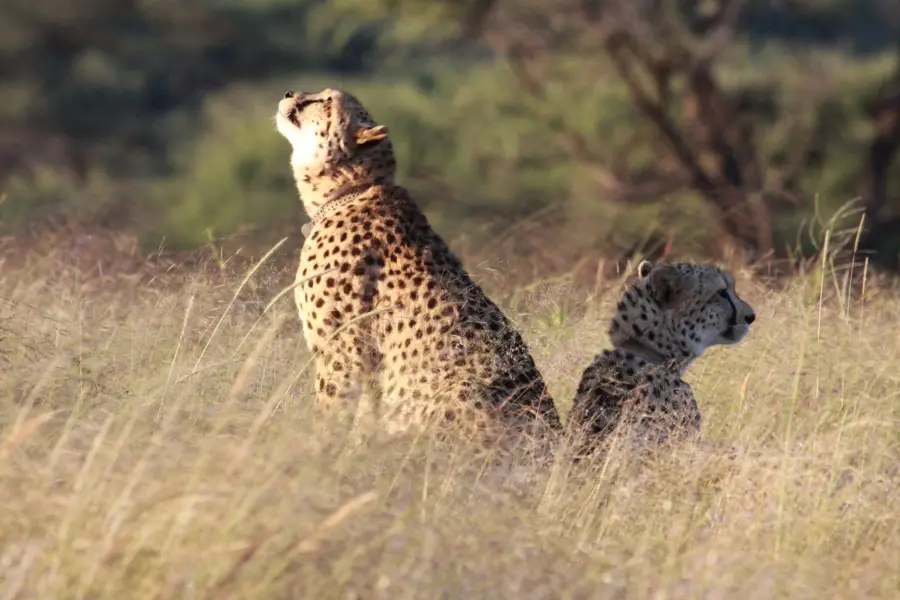
The AfriCat Foundation
The AfriCat Foundation was founded in the early '90s and formally registered as a non-profit organisation in August 1993. The Foundation has since grown significantly and what started out primarily as a welfare organisation, has over the years, identified the need to focus on education and research, as being essential...
The AfriCat Foundation was founded in the early '90s and formally registered as a non-profit organisation in August 1993. The Foundation has since grown significantly and what started out primarily as a welfare organisation, has over the years, identified the need to focus on education and research, as being essential to accomplishing our mission - the long-term conservation of Namibia's large carnivores.
Destinations
Luderitz
Lüderitz is a town situated on a bay on Namibia’s south-west coast. This remarkable town was the first German settlement in German South-West Africa, founded during the German colonial era in the Namib Desert, a region with a pure desert climate. The founder was the merchant Adolf Lüderitz from Bremen, who bought the bay in 1883 and established a trading post there. At the time, the bay was still known as Angra Pequena. During the colonial era, one of the small islands off the town’s coast was used by the Germans as a prison island.
The town still retains a German character, partly due to the large church with its pointed tower and the German-language street names. Fossil water in an aquifer keeps the town alive, but its lifespan is limited. As arid and lifeless as the land around the town may seem, life in the cold Atlantic Ocean is teeming. The sea there is significantly cooled by the Benguela Current, which flows from Antarctica along the west coast as far as the coast of Angola. It teems with penguins, seals, porpoises, dolphins and whales, all of which feed on fish and other marine life. Seabirds are also numerous, including Hartlaub’s gulls, gannets, cormorants and a number of terns.
After a railway worker happened to find a few diamonds in the sand in 1907, a veritable diamond rush broke out in the vicinity of Lüderitz. Kolmanskop is a settlement that was built specifically for the staff of the diamond company. However, the First World War and the sudden decline in the diamond trade led to the settlement’s decline. The abandoned houses were swallowed up by the dunes, and the ghost town is now a tourist destination accessible from Lüderitz.
The area south of the town is the ‘Sperrgebiet’, a region where no one is allowed to enter because diamonds are found in abundance there. The town is also home to several diamond fishermen, who are licensed by De Beers to fish for diamonds on the ocean floor.
The excess water from the town’s sewage treatment flows into the desert like a small stream. Along this artificial and somewhat dubious little stream, many antelopes (such as gemsbok) can be spotted. The stream ends in a small salt lake home to hundreds of flamingos.
Okonjima Nature Reserve
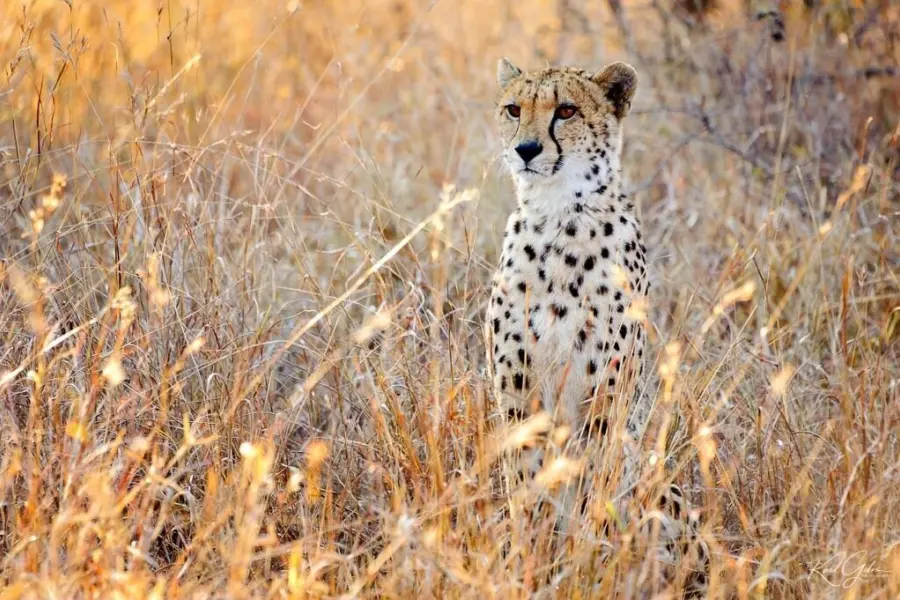
Halfway between Windhoek and Etosha lies the famous Okonjima Nature Reserve. The 22,000-hectare Nature Reserve is surrounded by 96 km of fence and was finally completed in 2010. Okonjima is home to AfriCat, where carnivores are rehabilitated to be released back into the wild. Here, the animals can once again become fully independent hunters in the middle of a protected area.
Johannesburg
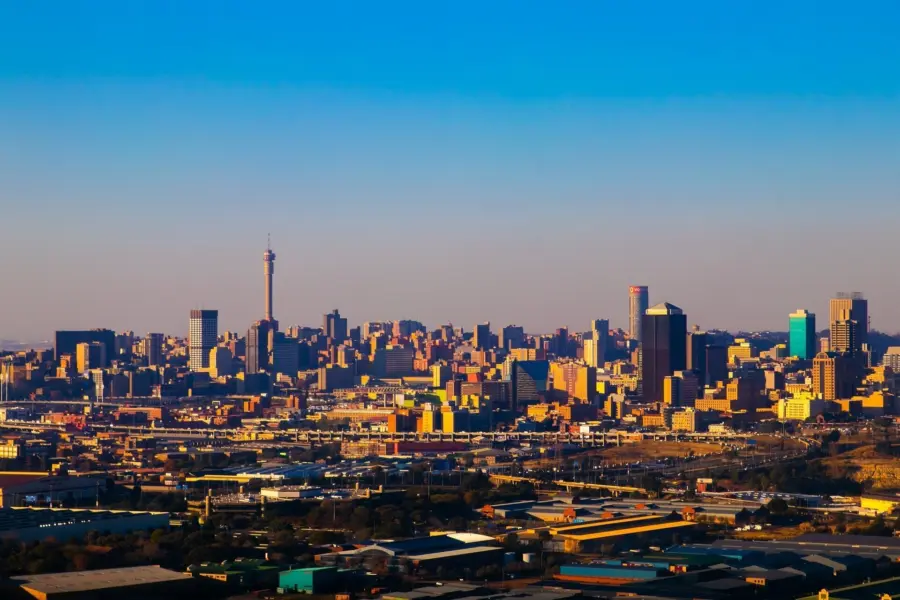
Johannesburg is South Africa’s largest city. It is also the economic heart of South Africa, home to all the major financial and industrial companies. Johannesburg was founded following the discovery of gold in the Witwatersrand in 1886. At that time, the Witwatersrand lay within the borders of the South African Republic, of which Paul Kruger was president. The Republic had been established in consultation with the British government, which was administering the Cape Province at the time. Following the discovery of gold, control of the region became a matter of dispute.
Johannesburg’s city centre is colourful, lively and exotic, with its diverse cultural offerings. Of particular interest is the ‘Carlton Centre’ on Commissaris Street. This skyscraper was built in the 1970s, stands 220 metres tall and remains the tallest building in Africa. On the top floor is a viewing platform called ‘The Best of Africa’. From a height of 202 metres, you can enjoy an impressive view over Johannesburg.
Outside the city centre, in the Fourways district, you’ll find the new theme park “Monte Casino”, whilst “Gold Reef City” is situated in the south of the city. Here, you can learn about the history of gold mining in an entertaining way. The new Apartheid Museum is also well worth a visit. And if you’re looking for the best shops in the country, head to Mandela Square in Sandton.

Gauteng
Gauteng is South Africa’s smallest province, but it is the commercial and administrative heart of the country and indeed of the whole of southern Africa.
The name Gauteng is the Sotho name for ‘Place of Gold’. In fact, a huge gold vein was discovered in this province in 1886, and gold quickly became the foundation of the national economy. During mining operations, further riches were unearthed, such as diamonds and coal.
But Gauteng is more than just cities, money and politics. For example, the Sterkfontein Caves were designated a World Heritage Site after bones dating back no less than 3.5 million years were found there. This site is also known as the Cradle of Humankind.
South Africa
One of the most culturally and geographically diverse places on earth, South Africa, affectionately known to locals as the 'Rainbow Nation', has 11 official languages, and its people are influenced by a fascinating mix of cultures. Discover Cape Town's gourmet restaurants, impressive art scene, vibrant nightlife and beautiful beaches. Enjoy a local braai (barbecue) in the community of Soweto, browse the bustling Indian markets in Durban, or taste some of the world's best wines at the numerous wine estates scattered across the Cape Winelands. Some historical attractions to explore include the Zululand battlefields of KwaZulu-Natal, the Apartheid Museum in Johannesburg, and Robben Island, just off the coast of Cape Town. Above all, the untamed wilderness is amazing: wildlife roams freely across huge unfenced game reserves such as the world-famous Kruger National Park.
Windhoek
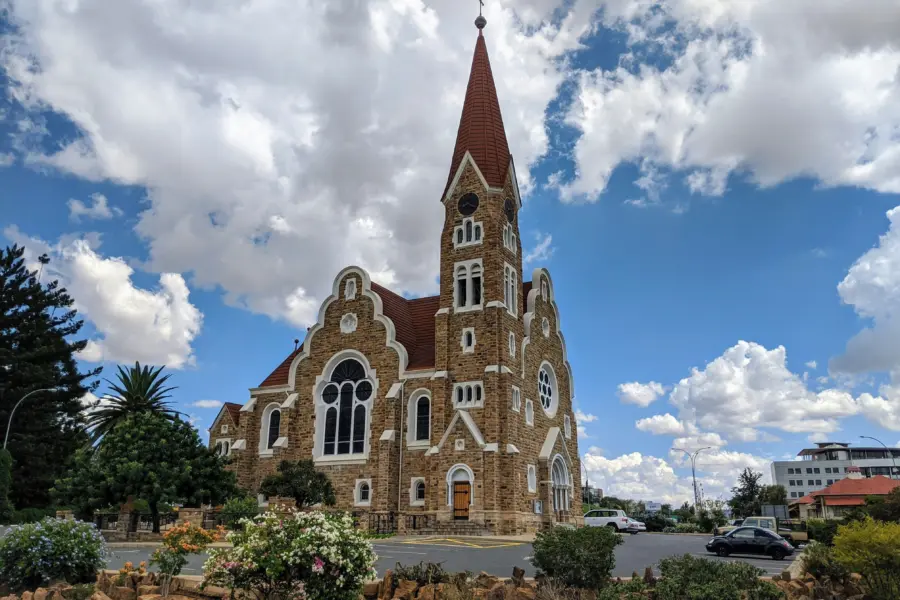
Windhoek is the capital of Namibia, home to an international airport and an abundance of restaurants, shops, entertainment venues and accommodation. The city is clean, safe and well organised, with a colonial heritage reflected in the many German restaurants and shops, and the widespread use of the German language. Windhoek has an interesting mix of historic architecture and modern buildings, many of which are worth seeing, including the Alte Feste (Old Fort), the 1896 Christuskirche (Christ Church), and the more contemporary Supreme Court.
Kalahari Namibia
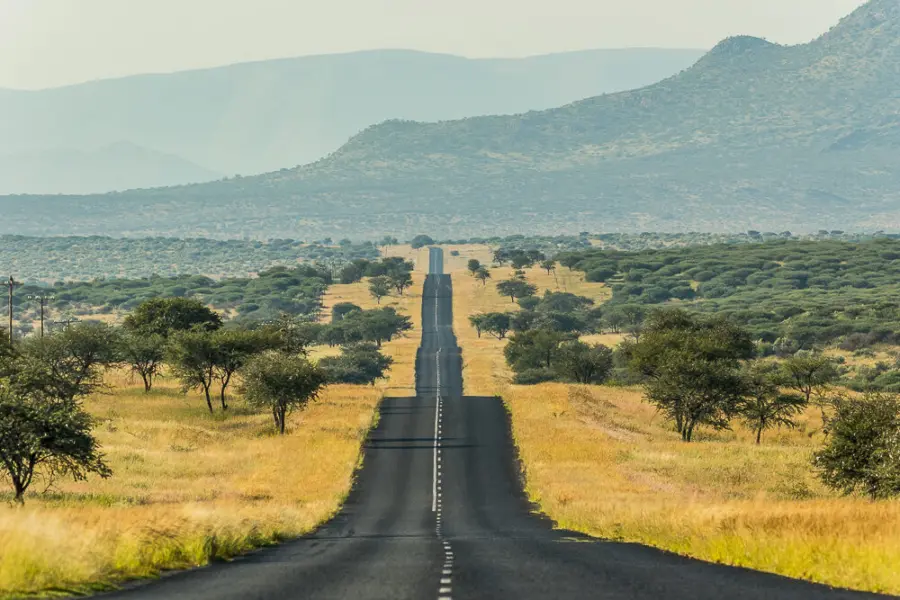
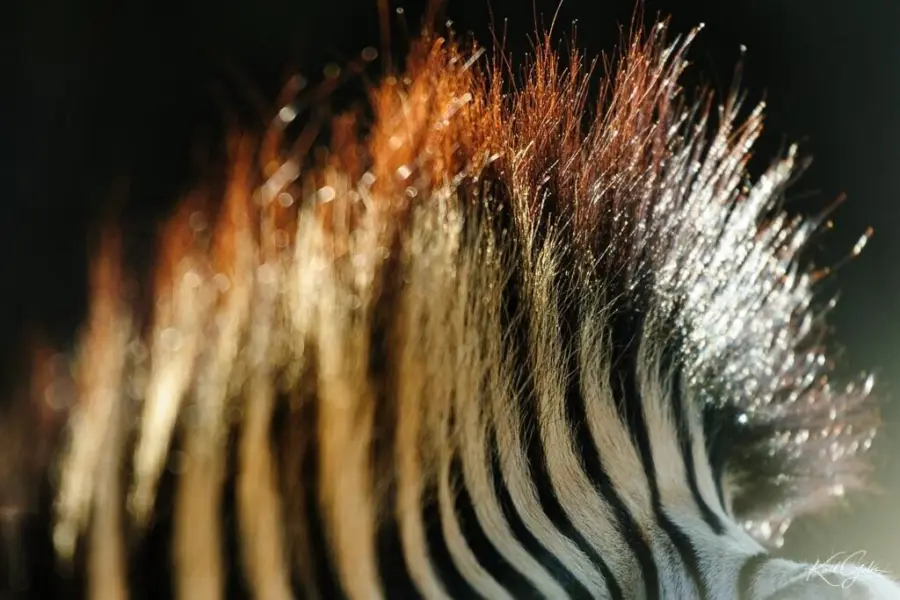
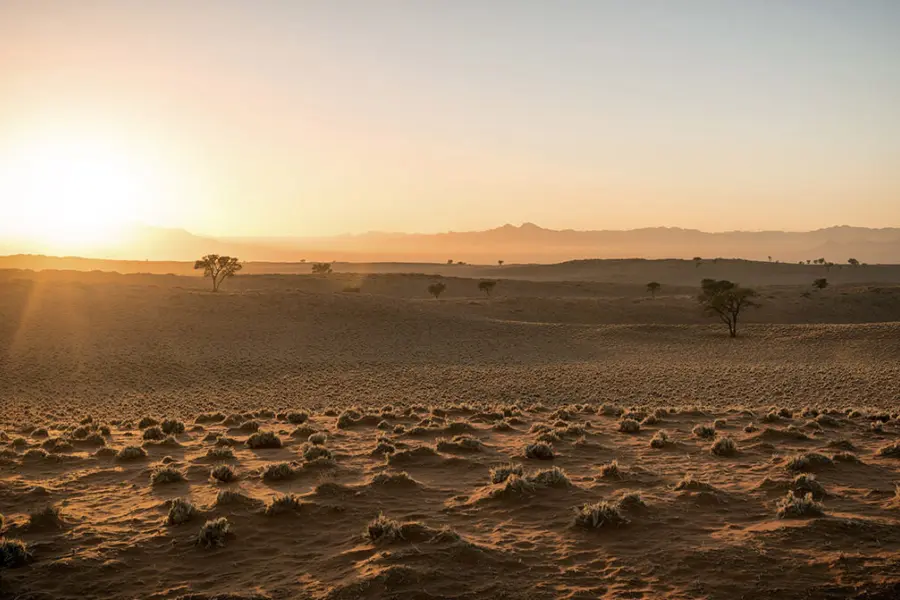
The Kalahari is an exceptionally beautiful 'Living Desert'. This mighty desert covers large parts of Botswana, Namibia and South Africa. It is also one of the last areas where the San-Bushmen live. The Kalahari in Namibia consists mostly of red sand covered with thin golden grass and dotted with acacia trees. Many animals can also be spotted, which have adapted to the living conditions of the Kalahari. There is a chance of seeing gemsbok, impala, jackals and cheetahs.

Southern Namibia
Southern Namibia is a harsh but beautiful region. From the Orange River to the Central Namibian highlands and between two deserts, South Namibia is epitomised by vast, slowly changing landscapes.
Aus
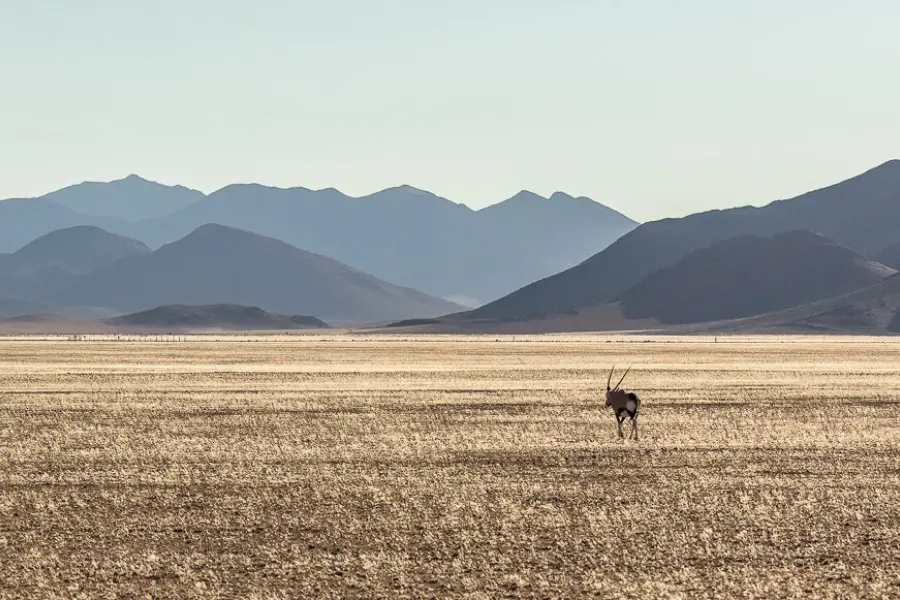
This region is characterised by the Succulent Karoo. The striking climatic features of the Succulent Karoo set it apart from all other deserts in the world. Rainfall is reliable and predictable, usually occurring in winter, and prolonged droughts are rare. The botanical diversity of the Succulent Karoo is unrivalled by any other arid region on Earth, and it is the world’s only arid plant hotspot.
The ecoregion is home to more than 5,000 species of higher plants, of which nearly 40 per cent are endemic and 18 per cent are threatened. It has the richest succulent flora in the world and is home to around 10,000 species of succulents. Other unique features include the diversity of miniature succulents (435 species) and geophytes (bulb-like plants, 630 species). The ecoregion is also a centre of diversity and endemism for reptiles and many invertebrate taxa.
The Namib Desert ecoregion in the north is characterised by extremely low and variable summer rainfall (less than 50 mm per year) and extremely sparse vegetation cover, dominated by ephemerals. To the east lies the Nama Karoo ecoregion.
Sossusvlei
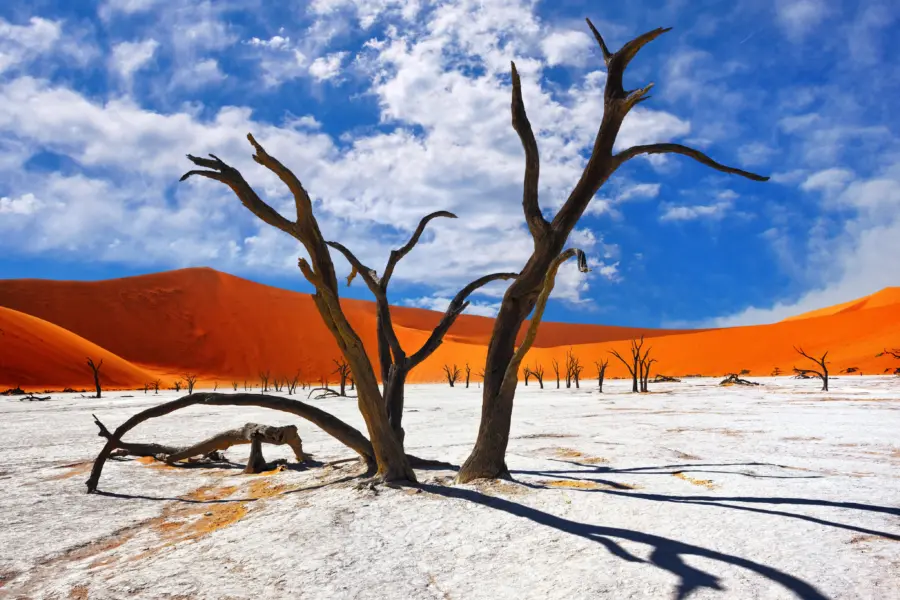
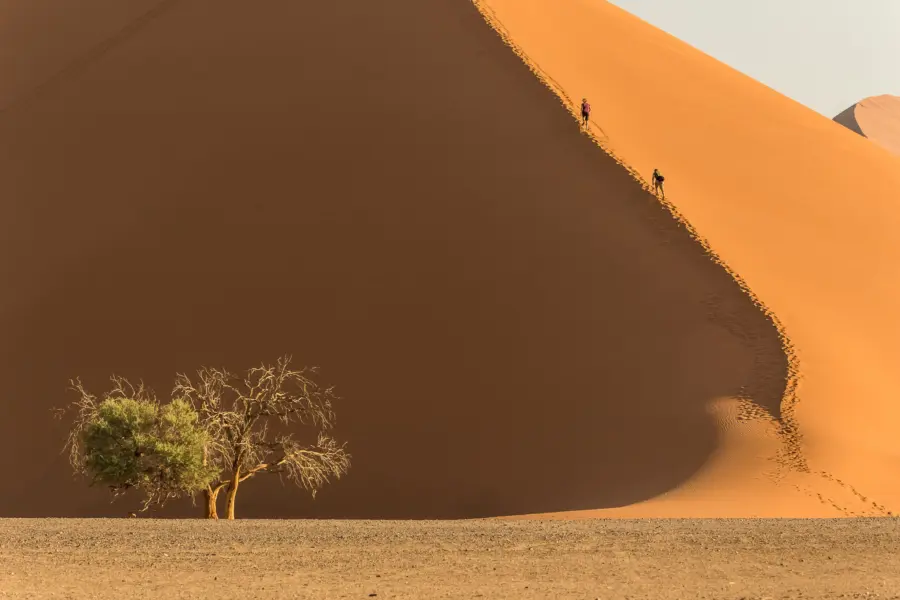
Sossusvlei is where you’ll find the iconic red sand dunes of the Namib Desert. The clear blue skies contrast with the gigantic red sand dunes, making this one of Africa’s natural wonders and a perfect spot for photographers.
As well as the attractions near Sossusvlei such as Dune 45, Hiddenvlei, Big Daddy and Deadvlei, other sights in the area include the Sesriem Canyon and the Namib-Naukluft National Park.
Swakopmund
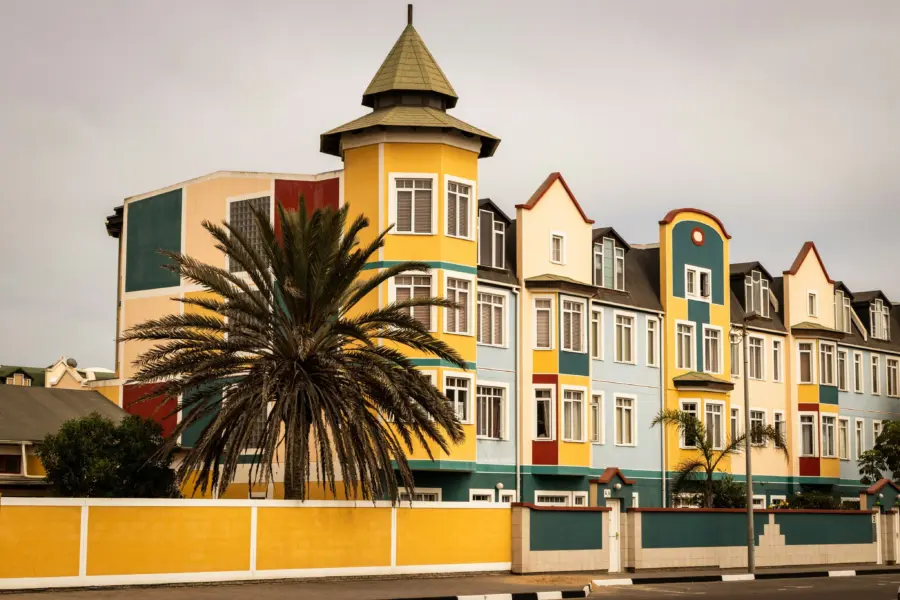
Swakopmund is a small town on the Atlantic coast and has a distinctly German character. Even today, German is still widely spoken there, and you can order Kaffee mit Kuchen in a genuine Konditorei.
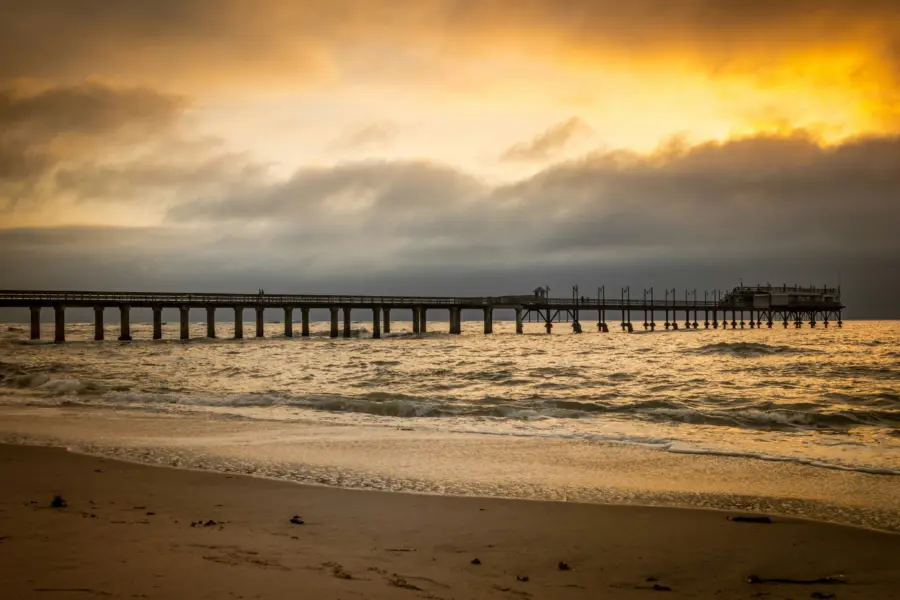
There’s plenty to do in and around Swakopmund. An hour’s drive to the north takes you to Cape Cross, home to a sea lion colony numbering many thousands of animals. The noise is deafening and the smell isn’t always pleasant, but the sight of these thousands of animals is certainly worth it. You can also visit the beach; horse riding, skydiving and even a hot-air balloon ride are among the options.
It’s definitely worth exploring the marine life on a catamaran, where dolphins swim alongside the boat, pelicans dive into the sea in search of fish, and sea lions come to take a look from Cape Cross.
Twyfelfontein
Twyfelfontein is the name of a spring and the valley in which it lies, in the mountains of Damaraland in Namibia. When white farmers settled in the region in 1947, the spring proved less reliable than expected. It sometimes provides water and sometimes does not. Time and again, people wondered whether there would be water or not. That is why the spring was given the name Twyfelfontein.
The valley owes its international fame to the countless rock paintings and engravings found on the rocks. The drawings were created by the San people and are in some cases thousands of years old. There are at least 2,500 inscriptions and several thousand drawings on the rock faces, dating from 300 BC to the 19th century. Most of the engravings depict animals such as gemsboks, lions, elephants and goats. Some show tracks and geometric figures, which are thought to indicate watering holes.
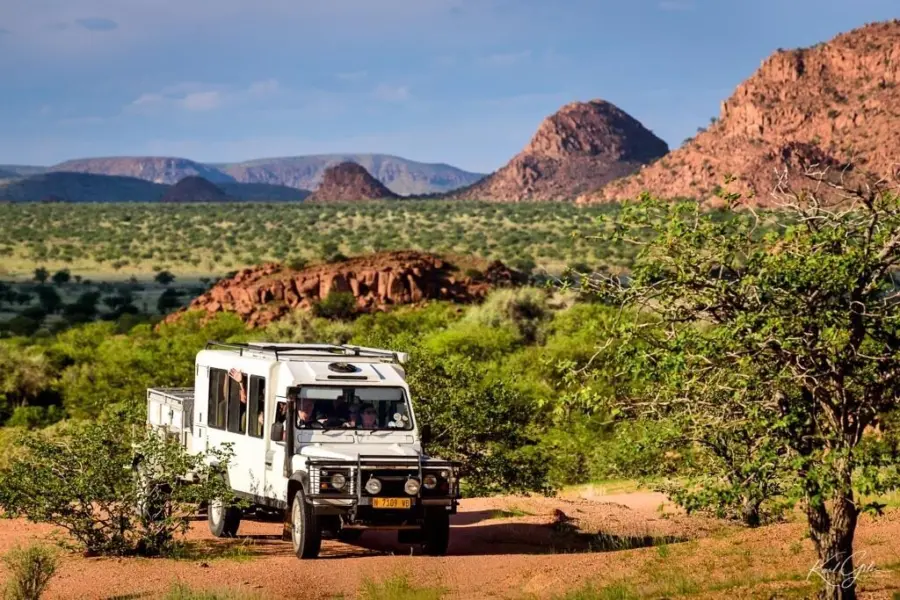
Etosha South
Located just south of the Etosha National Park border, Etosha South forms the southern region of this wild paradise. Ongava Private Game Reserve shares the southern border with Etosha National Park and offers a range of luxury lodges overlooking picturesque landscapes dotted with abundant flora and fauna. The national park can be accessed via the southern entrance at Andersson's Gate. Visitors can catch a glimpse of a variety of wildlife including: lion, giraffe, elephant, white and black rhino. Popular activities include game drives, tracking rhinos on foot, guided nature walks or watching the sunset over this beautiful landscape.
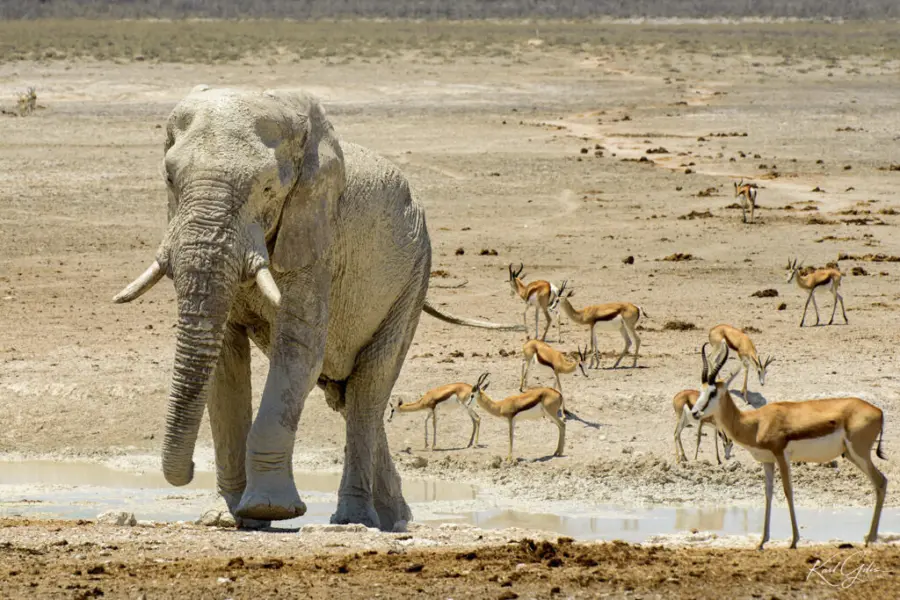
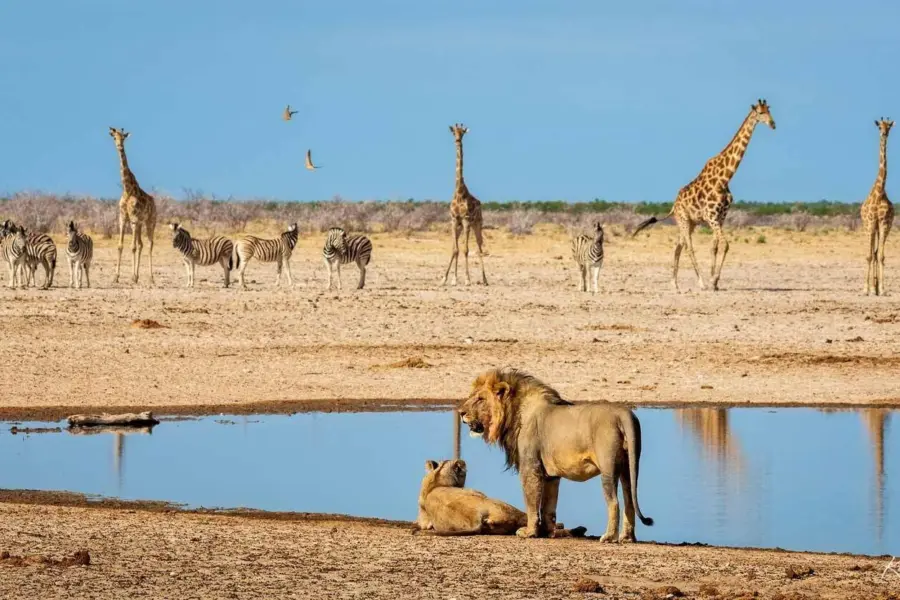
Etosha West
Etosha West, located in the western part of Etosha National Park, is a new addition to this world-renowned nature reserve. Visitors to Etosha West can look forward to exploring the beautiful Namibian landscape to the north, which is characterised by lush undulating terrain and reddish-brown soil, providing a stark contrast to the white, dusty clay soil on the vast plains of Etosha East. The area has numerous waterholes that attract elephants, rhinos, leopards, lions and several species of animals. Don't miss this chance to catch a glimpse of the rare Hartmann's Mountain Zebra and black-faced impala.
Etosha National Park
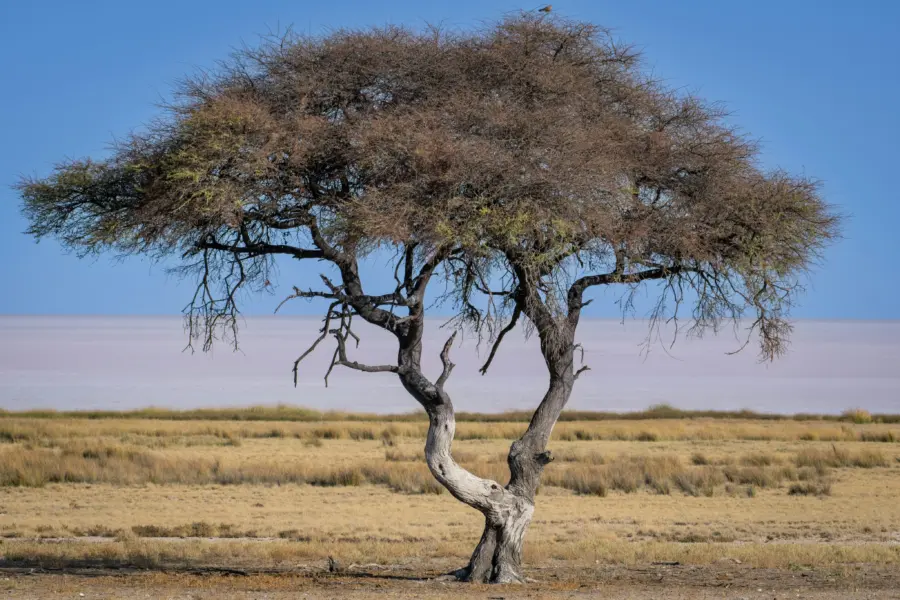
Etosha means ‘Big White Spot’ and is one of the larger nature reserves in Southern Africa. The park is roughly three-quarters the size of the Netherlands and consists largely of a vast salt pan surrounded by bush and scrub. At the natural and man-made waterholes, you can spot large numbers of wildlife.
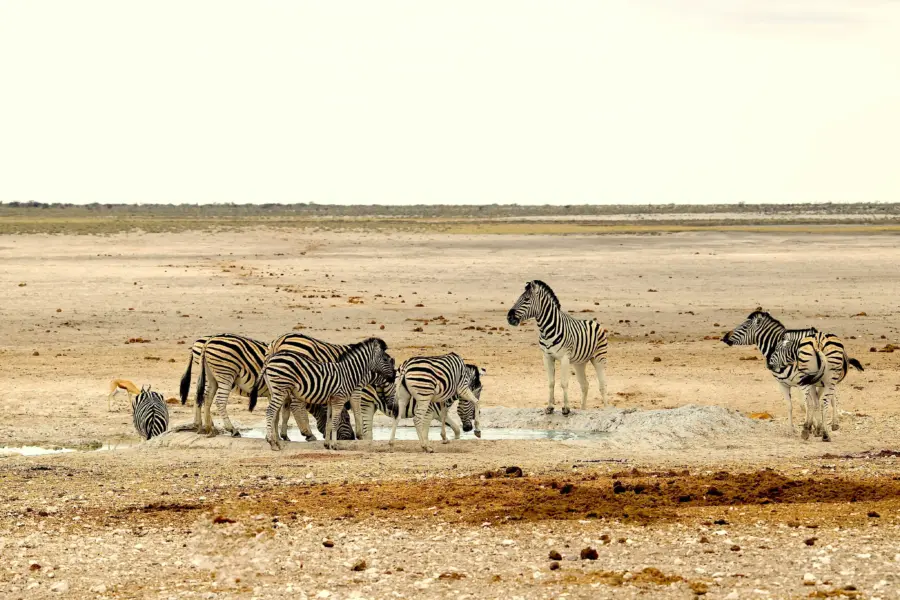
Elephants, zebras, lions and various species of antelope can be found at these waterholes, which are vital for survival during times of drought. Some of the watering holes are situated closer to your accommodation, and in the evening, after dark, you can enjoy watching rhinos and large herds of elephants coming to drink. The watering holes are often illuminated, which gives this nocturnal experience a unique character.
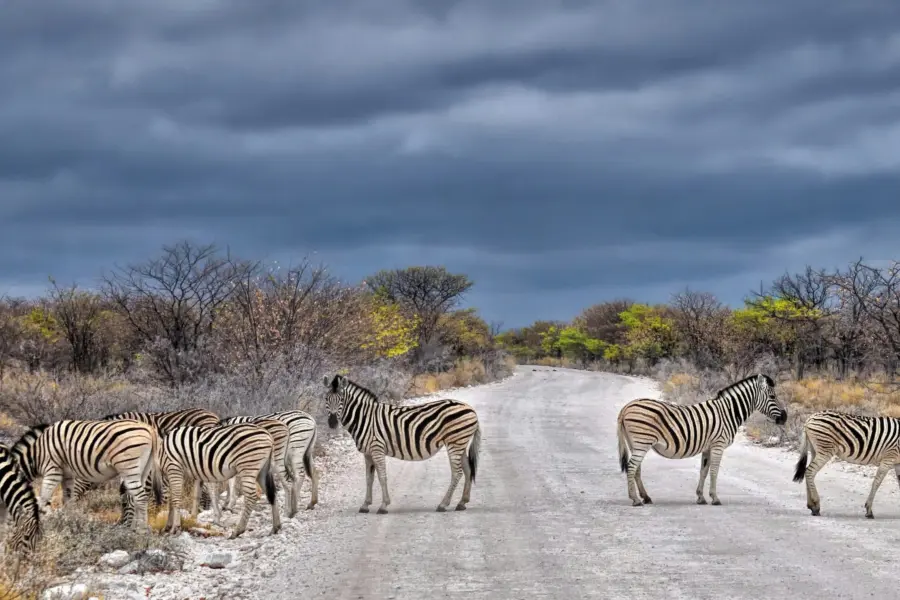
Etosha East
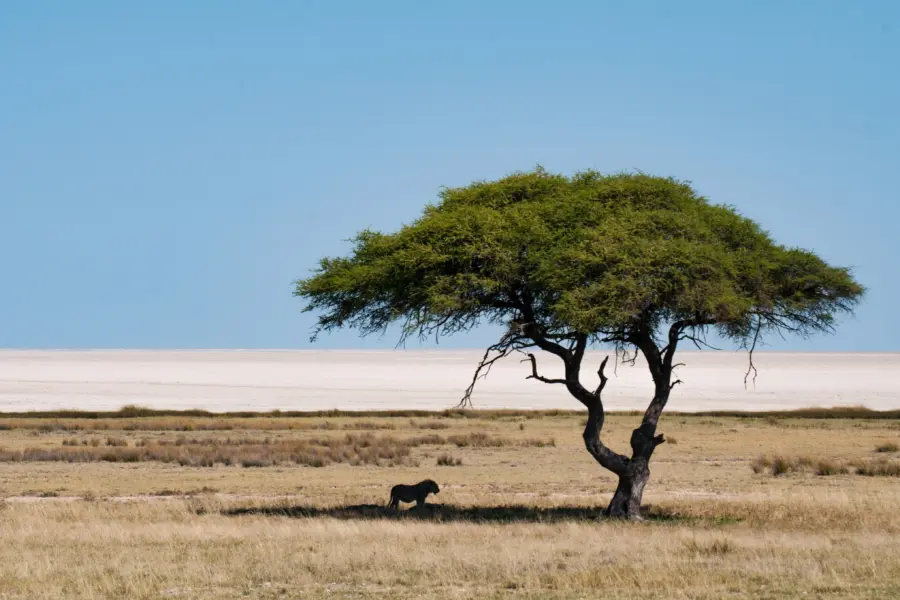
In the vast, arid expanse of northern Namibia lies one of Southern Africa’s most beloved game reserves. Etosha National Park offers an excellent opportunity to spot wildlife in one of Africa’s most accessible locations. Zebras and springboks are scattered across the endless horizon, whilst the numerous waterholes attract the endangered black rhinoceros, lions, elephants and large numbers of antelopes.
Etosha, meaning ‘place of dry water’, encompasses a vast plain (or pan) of approximately 5,000 km². The ‘Pan’ forms a vast, parched, silvery-white backdrop of shimmering mirages in an area of semi-arid savannah grassland. The pan itself only holds water after very heavy rainfall – sometimes for just a few days a year – but this is enough to stimulate the growth of blue-green algae, which in turn attract thousands of flamingos.
Waterberg Region
The Waterberg Plateau, east of Otjiwarongo, towers high above the surrounding plains. The 20-kilometre-wide and 50-kilometre-long table mountain consists of porous sandstone. Rainwater seeps through the permeable rock and collects on top of an impermeable layer of clay at the base.
Although the plateau is dry at the summit, there are many permanent water sources at the foot of the mountain. The vegetation is therefore very lush, green and diverse. Wild fig trees, lilies and coral trees grow here. The area is also rich in wildlife.
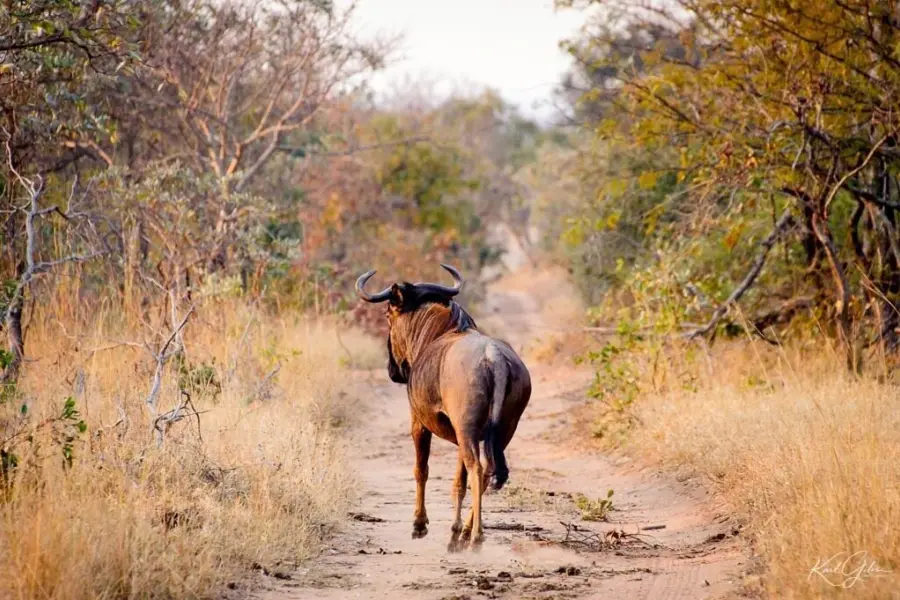
In 1972, Waterberg and the surrounding area – covering a total area of approximately 400 square kilometres – became a protected nature reserve. The park has now been granted National Park status. Endangered species such as the white and black rhinos, sable antelope, Damara dik-diks and blue wildebeest live in the park. Furthermore, the Waterberg is the only place in Namibia where the Cape vulture can be found. These enormous birds have a wingspan of three metres. They belong to a group of bird species that are almost completely extinct.
The Waterberg region forms part of the Herero people’s most important territory. In August 1904, some 40,000 Herero men, women and children, led by Samuel Maharero, were attacked by 1,600 German colonial soldiers. Only a few Herero managed to escape by crossing the dry Kalahari Desert (Omaheke) into Botswana. A military cemetery serves as a memorial to these tragic events.
Namibia
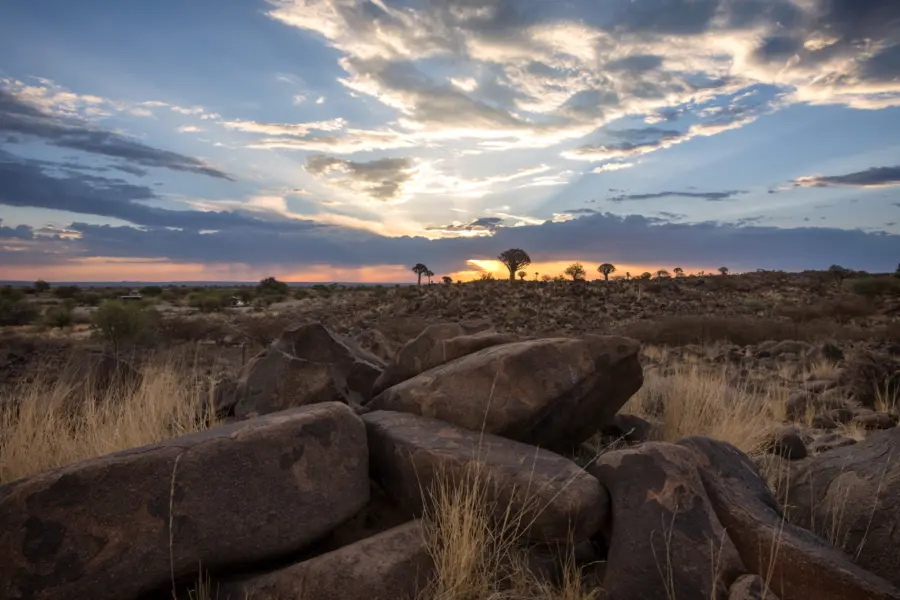
With its well-developed infrastructure, some of the best tourist facilities in Africa and an impressive list of breathtaking natural wonders, exploring Namibia is truly a delight. Visit the capital Windhoek and the beautiful coastal town of Swakopmund to discover remnants of the country's German influence, reflected in its architecture, culture, gastronomy and annual Oktoberfest celebrations. To properly appreciate this extraordinary country, you need to get out of town in search of the remarkable natural landscapes Namibia has to offer. These include: the impressive Fish River Canyon Park; the sprawling Etosha National Park filled with local animal species, such as desert lions, desert elephants and the Hartmann's Mountain Zebra; the terrifyingly beautiful Kalahari Desert; and, of course, the Namib Desert that stretches for almost 1,000 km along the beautiful Atlantic coast. Namibia is an ideal destination for travellers seeking an unforgettable African experience in uniquely beautiful unspoilt wilderness.
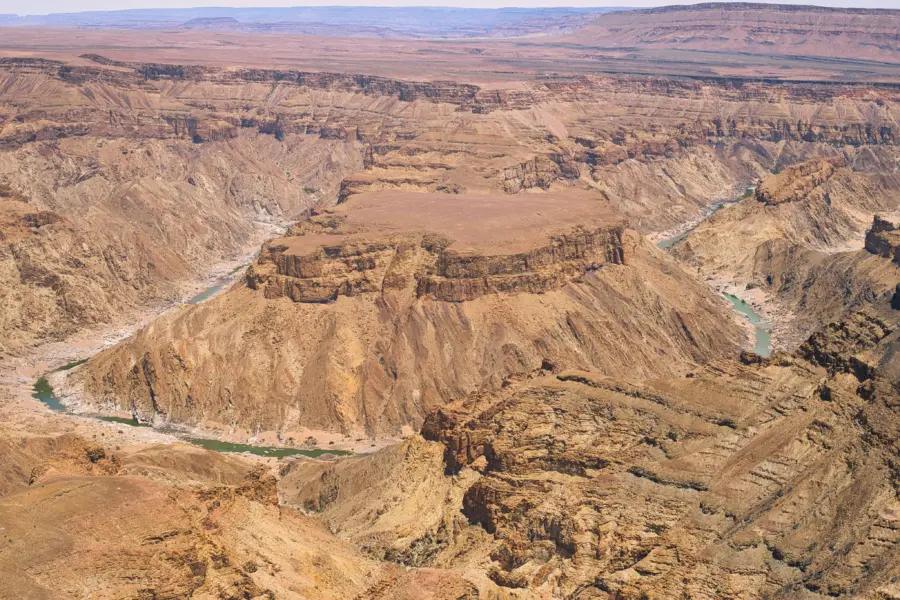
Fish River Canyon
The Fish River Canyon (Afrikaans: Visrivier Canyon or Visrivier Afgronde, German: Fischfluss Canyon) in Namibia is the second-longest canyon in the world, after the Grand Canyon in the United States. The canyon is approximately 160 km long, up to 27 km wide and, in some places, up to 550 metres deep.
The canyon lies along the lower reaches of the Vis River. This river does not carry water all year round and is not navigable. The water is orange in colour. The canyon begins at the village of Seeheim and ends at Ai-Ais. From there, the river flows into the Orange River along the border with South Africa.
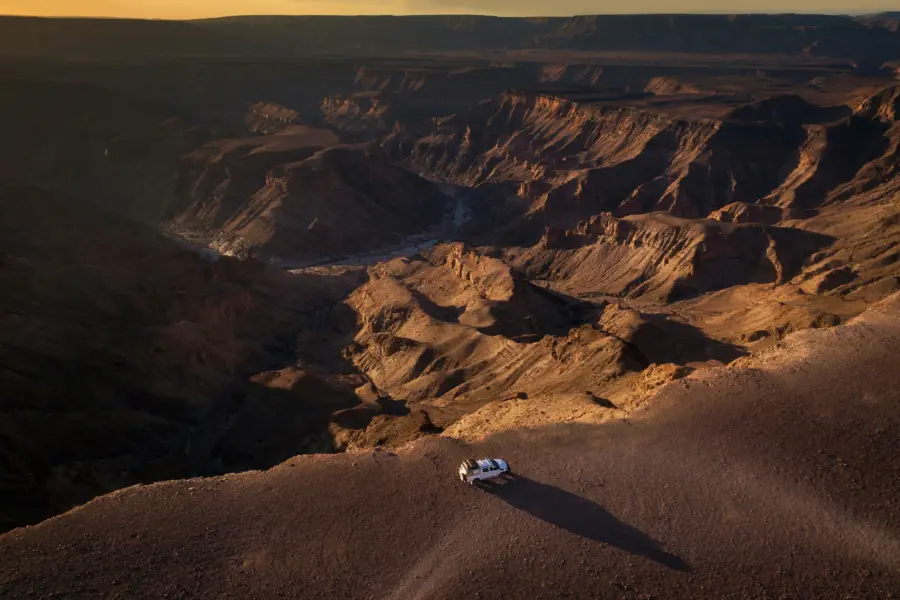
Namib-Naukluft National Park
Stretching almost 50000 square kilometres across the red-orange sands of the Namib Desert over the Naukluft Mountains to the east, the Namib-Naukluft National Park is Africa's biggest wildlife reserve and the fourth largest in the world. Despite the unforgiving conditions, it is inhabited by a plethora of desert-adapted animals, including reptiles, buck, hyenas, jackals, insects and a variety of bird species. One of the main attractions of the park are the ancient dunes of Sossusvlei, home to some of the tallest dunes in the world rising over 300 metres from the desert floor. This magnificent landscape features rolling dunes, rugged moonscapes, lagoons, wetlands and mudflats. Visitors can look forward to a number of impressive sights including: the picture-perfect Dune 45, standing 170 metres high; the Welwitschia Plains, otherworldly lunar terrain dotted with the endemic plants; and the Dead Vlei, a photographer's dream.
Otjiwarongo
Set on the TransNamib railway in central-north Namibia, near Etosha National Park, Otjiwarongo, meaning 'the place of fat cattle', is an affluent town with a suburban feel and numerous attractions. The town is known for its excellent conservation projects, which include several parks protecting large wild cats, such as the famous Cheetah Conservation Fund, and the Crocodile Ranch, where visitors can view and learn about these fascinating creatures. Hiking, guided nature walks, and safaris are popular activities. The lively, traditional craft market adds appeal. History enthusiasts should make sure to visit the Locomotive No 41 monument, and the culturally significant site of the Battle of Waterberg on the Waterberg Mountain.
Ongava Private Game Reserve
This reserve borders with Etosha National Park. Considered one of the finest private game reserves in the region, Ongava Game Reserve has global recognition for exceptional conservation, pioneering research and exciting safari experiences. The reserve is home to the lion, eland, impala, zebra and a variety of other antelope species, among others. In addition, this is one of the few private reserves in Southern Africa where both black and white rhinoceros can be observed. As many as 340 bird species also live in this area.
Damaraland
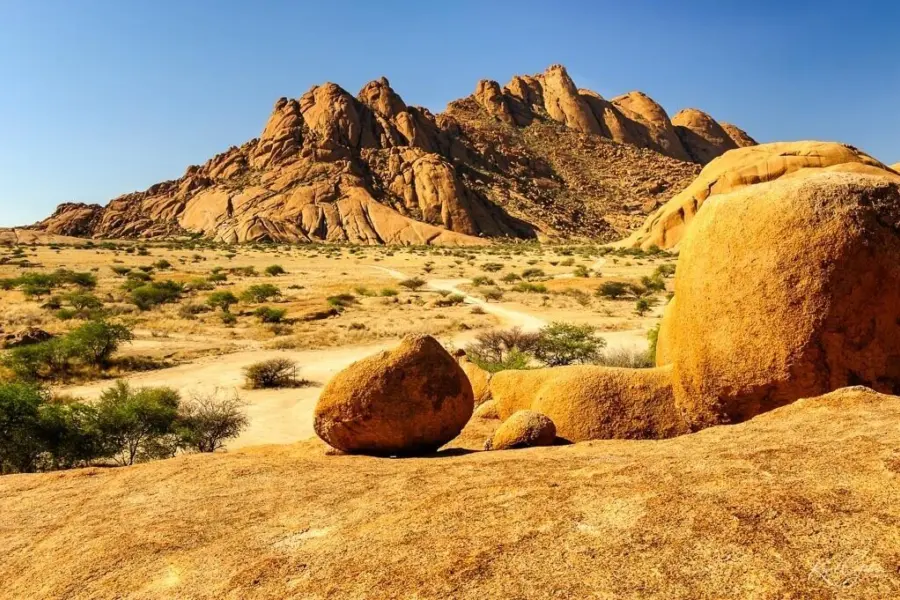
Enjoy the stunning landscapes of Damaraland Enormous, untamed and rugged, Damaraland is an exceptionally scenic landscape of open plains and spectacular rock formations. The main attractions are Spitzkoppe, the Brandberg, Twyfelfontein, Vingerklip and the Petrified Forest. In addition, this gigantic area is home to desert elephants, among others, which have fully adapted to the living conditions of this rugged landscape.
Central Namibia
The central Namibian highlands are much cooler and less extreme than the arid lowlands that make up the majority of the country. This is an ideally suited area for cattle breeding, and more recently large and small game breeding.
Northern Namibia
Northern Namibia stretches from the remote Kunene River in the west of the country to the densely populated region of Ovamboland in the north-east. Central Ovamboland forms part of Namibia’s vast Kalahari system and is home to one of Africa’s largest wildlife parks, Etosha National Park. The park offers phenomenal opportunities for wildlife viewing, and travellers can look forward to visiting the spectacular Etosha Pan.
Damaraland lies in the north-west, featuring some of the most impressive rock art adorning this rugged landscape. Further east, the Caprivi stretches for over 450 kilometres and is Namibia’s most tropical region. It serves as a corridor for African elephants migrating to Angola. Northern Namibia is a remote wilderness with incredible landscapes and magnificent wildlife, making it more than worth visiting.
Namib
The Namib Desert, or simply the Namib, is considered to be the oldest desert in the world. This sandy desert, approximately 200 kilometres wide, stretches from north to south along Namibia’s Atlantic coast for a distance of around 2,000 kilometres, from Angola in the north to the Orange River in the south. However, when people refer to the Namib, they usually mean the sea of sand that stretches between Lüderitz and Swakopmund. This sea of sand was inscribed on the UNESCO World Heritage List in 2013.
The Namib Desert forms part of the Namib-Naukluft National Park, which is Africa’s largest wildlife reserve. In the centre of the desert lies Sossusvlei, a picturesque valley where water occasionally collects. Together with the neighbouring Dodevlei, Sossusvlei is one of the country’s major tourist attractions.
Greater Windhoek
Windhoek, Namibia's capital, is surrounded by beautiful mountains, fertile farmlands, lodges and luxury guest farms. The landscape of the Greater Windhoek area surrounding this bustling city is characterised by vast valleys, thick bush, rocky hills and a golden savannah. Visitors can enjoy the many birds, and view large amounts of other wildlife to the north.Also be sure to visit the more arid eastern part with its olive and potato plantations; explore the rolling hills of the Khomas Hochland Mountains in the west of Greater Windhoek and enjoy the epic views along a number of scenic passes leading to the high plateau, including Bosua Pass, Gamsberg Pass and Spreetshoogte Pass.
Namibia trip | Luxury self-drive through Namibia
During this trip, you will drive yourself through Namibia in a comfortable 4x4 and stay in luxury lodges in remote locations. Accommodations, itineraries and daily planning are worked out for you in advance, so you know exactly where you are going and what you can do, without having to arrange anything yourself.
We offer the described trip from €8,495 per person.
The trip price is an indication and is subject to availability and travel period, among other things.
Included
• International flights between Johannesburg and Windhoek in Economy Class (including 20kg of hold luggage)
• Accommodation in high-quality and distinctive lodges, tented camps and hotels
• All meals as specified in the ‘itinerary’
• Toyota Fortuner 4x4 automatic hire car or equivalent, including an additional driver, insurance, taxes and excess waiver
• All necessary private transfers as mentioned
• All excursions as mentioned in the ‘itinerary’
• National park entrance fees where applicable
• Meet & Greet on arrival
• Detailed day-by-day itinerary
• National Geographic or similar travel guide
• Booking fees (worth €50)
Positive impact of your trip:
• Contribution of €50 per person towards a positive impact via the Avila Foundation
• Accommodation at Wilderness Kulala Desert Lodge & Okonjima Luxury Bush Camp
Not included
• Intercontinental flights to and from Johannesburg
• Room category upgrade
• Travel and/or cancellation insurance
• Visa fees
• Local car hire costs, such as administration fees and fuel
• National park entrance fees, where applicable
• Meals and excursions not specified
• Contribution to the emergency fund (€2.50 per booking)
• SGR contribution (€5 per person)
• Any tips